Tax Planning · 🇮🇳 India
New vs Old Tax Regime in 2026: Which One Actually Saves You More?
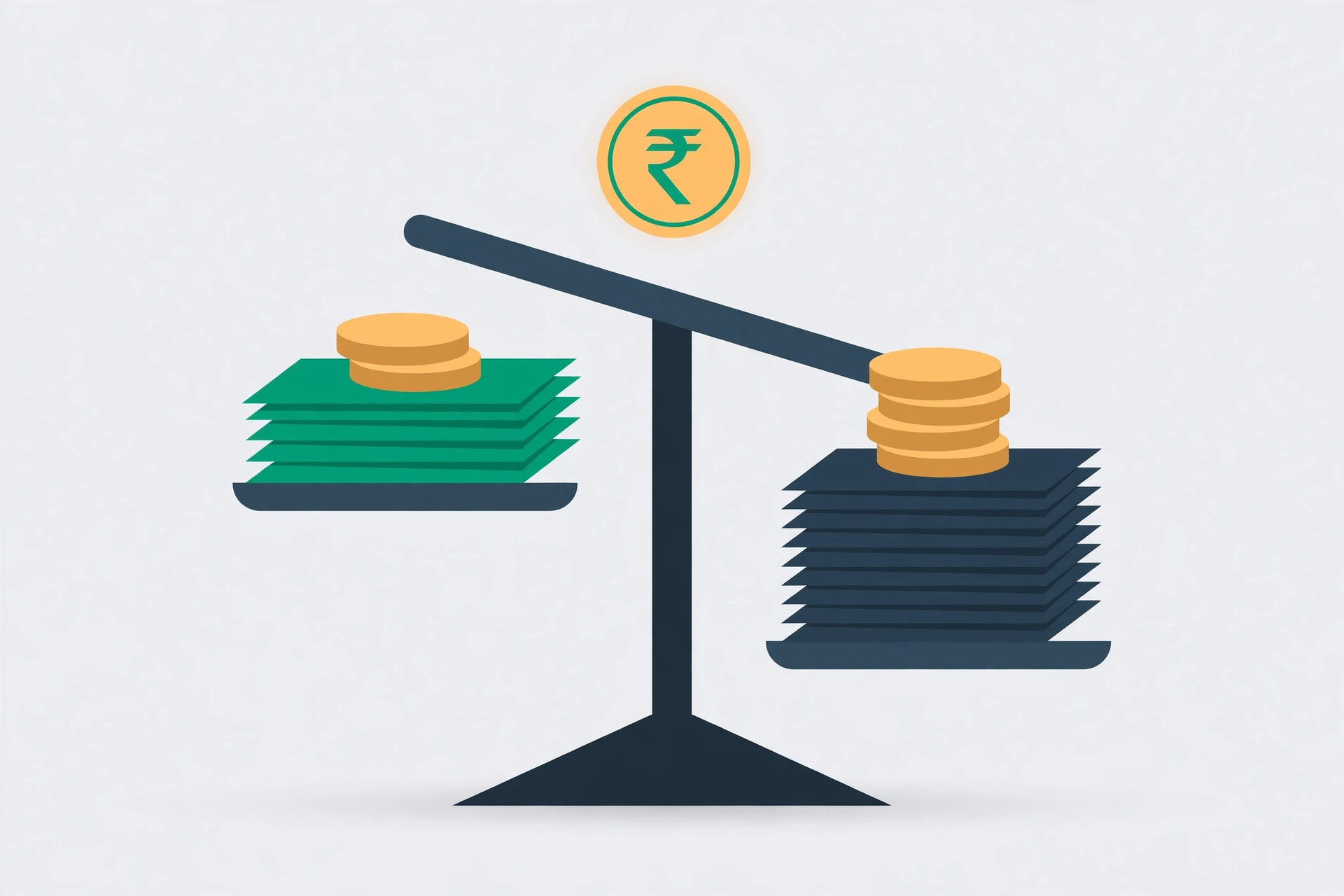
Last April, my friend Rohan sat across from me with a salary slip in one hand and a tax calculator open on his phone in the other. "Bhai, HR is asking which regime I want. Old or new?" He'd heard the new regime is "better for everyone now." His father insisted the old one is always better "because of 80C." Both of them were confident. Both of them were half-wrong. This question — new vs old tax regime — is the single most common tax confusion in India right now, and the honest answer is: it depends on your salary and your deductions. Here's how to figure out yours in about ten minutes.
First, a quick orientation. India has two parallel income tax systems right now. The old regime is the classic one: higher tax rates, but you can reduce your taxable income with deductions — 80C investments, HRA, 80D health insurance, home loan interest, and so on. The new regime (also called the default regime since FY 2023-24) has lower slab rates but almost no deductions. You can't claim 80C, HRA, or most other popular deductions under it.
The big plot twist came in Budget 2025. For FY 2025-26, the new regime got a massive upgrade: with the Section 87A rebate, annual income up to ₹12 lakh is effectively tax-free — and with the ₹75,000 standard deduction for salaried people, that's really about ₹12.75 lakh of salary with zero tax. That reshaped the maths for middle-class earners. But it didn't make the old regime dead. Not even close.
Tax rules in this guide were verified as of October 2026 for FY 2025-26. Slabs, rebates, and deduction rules change with each Budget — verify current provisions on the official sources linked in the article before filing.
The New Regime Slabs for FY 2025-26 (AY 2026-27)
Here's what the new regime actually charges, as of 2026. No deductions except the standard deduction and a couple of minor ones — but much wider nil-tax territory than before (verify current slabs on incometax.gov.in before filing):
| Annual income | Tax rate (new regime) |
|---|---|
| Up to ₹4 lakh | Nil |
| ₹4 lakh – ₹8 lakh | 5% |
| ₹8 lakh – ₹12 lakh | 10% |
| ₹12 lakh – ₹16 lakh | 15% |
| ₹16 lakh – ₹20 lakh | 20% |
| ₹20 lakh – ₹24 lakh | 25% |
| Above ₹24 lakh | 30% |
Now the part that matters most: the Section 87A rebate. Under the new regime, if your total taxable income is ₹12 lakh or less, the rebate wipes your entire tax out. You pay nothing. Marginal relief also applies just above ₹12 lakh, so you don't get slammed the moment you cross it — you only pay tax on the amount exceeding ₹12 lakh, roughly speaking. Add the ₹75,000 standard deduction for salaried employees, and a salary of up to ₹12.75 lakh means zero tax in FY 2025-26. For someone earning ₹9–12 lakh a year — a huge chunk of India's salaried class — the new regime is now a no-brainer. No 80C gymnastics needed.
The Old Regime Slabs (Unchanged)
The old regime slabs haven't moved in years. For individuals below 60:
| Annual income | Tax rate (old regime) |
|---|---|
| Up to ₹2.5 lakh | Nil |
| ₹2.5 lakh – ₹5 lakh | 5% |
| ₹5 lakh – ₹10 lakh | 20% |
| Above ₹10 lakh | 30% |
Under the old regime, the 87A rebate covers income only up to ₹5 lakh (₹12,500 rebate). The standard deduction for salaried people is ₹50,000. The rates look brutal compared to the new regime — 30% kicks in at just ₹10 lakh — but the old regime's power isn't in the slabs. It's in the deductions.
What the Old Regime Still Lets You Claim
This is where the old regime fights back. Stack enough deductions and you can drag a ₹15–20 lakh salary down into much lower tax territory. The heavy hitters:
- 80C — ₹1.5 lakh: EPF, PPF, ELSS, life insurance premiums, children's tuition fees, home loan principal repayment, NSC, 5-year tax-saving FDs.
- 80D — up to ₹25,000 (₹50,000 for senior citizens): health insurance premiums for yourself, family, and parents.
- HRA (House Rent Allowance): often the biggest one for people living on rent in metros — the exempt portion depends on your salary, rent paid, and city.
- Home loan interest — up to ₹2 lakh per year on a self-occupied property (Section 24b).
- 80CCD(1B) — ₹50,000 extra for NPS contributions, over and above 80C.
- 80TTA/80TTB: savings account interest (₹10,000 / ₹50,000 for seniors).
- Standard deduction — ₹50,000 for salaried employees (available in both regimes, just a different amount in the new one).
A salaried person paying rent in Mumbai, contributing to EPF, holding a term plan, and paying health insurance premiums can realistically claim ₹3–4.5 lakh in deductions. On a ₹16–18 lakh salary, that can make the old regime genuinely competitive — sometimes outright cheaper.
The Breakeven Math: When Does Each Regime Win?
Here's the practical rule most tax advisors use. If your total deductions are low (under ~₹2–2.5 lakh), the new regime almost always wins — its lower slabs and the ₹12 lakh rebate do the heavy lifting. If your deductions are high (₹4 lakh+), the old regime usually wins, especially at salaries above ₹15 lakh.
The fuzzy zone is roughly ₹13–20 lakh of salary with ₹2.5–4 lakh in deductions. That's where you genuinely have to compute both. Let me walk through two realistic examples.
Example 1: Ananya, 27, Bengaluru — ₹11 lakh salary, minimal deductions
Ananya rents a shared flat, has EPF auto-deducted (~₹70,000/year), and that's about it — no insurance, no 80C investments, HRA claim is small since her rent is modest. Total deductions: roughly ₹1.2 lakh.
New regime: ₹11,00,000 − ₹75,000 (standard deduction) = ₹10,25,000 taxable → under ₹12 lakh → zero tax (87A rebate).
Old regime: ₹11,00,000 − ₹50,000 − ₹1,20,000 = ₹9,30,000 taxable → roughly ₹98,500 tax before cess.
New regime wins by a mile. Ananya shouldn't even think twice.
Example 2: Rohan, 38, Mumbai — ₹19 lakh salary, very heavy deductions
Rohan pays ₹45,000/month rent (HRA exemption of ~₹3.9 lakh), maxes 80C at ₹1.5 lakh, pays ₹50,000 in health insurance premiums (80D), has a home loan with ₹2 lakh annual interest, and puts ₹50,000 in NPS. Total deductions: roughly ₹8.4 lakh.
New regime: ₹19,00,000 − ₹75,000 = ₹18,25,000 taxable → slab tax ₹1,65,000 + 4% cess ≈ ₹1,71,600.
Old regime: ₹19,00,000 − ₹50,000 − ₹8,40,000 = ₹10,10,000 taxable → ₹1,15,500 + 4% cess ≈ ₹1,20,100.
Old regime wins by around ₹51,000. For Rohan, the old regime isn't nostalgia — it's money. Notice how much deduction it took: ₹8.4 lakh. With "only" ₹5–6 lakh in deductions at this salary, the new regime's wider slabs would still win — which is exactly why you compute instead of assuming.
These are rounded illustrations, not exact computations — cess, surcharge, and exact HRA formulas shift the final numbers. But the pattern holds: low deductions → new regime; high deductions → old regime.
Common Mistakes People Make Choosing
- Assuming "new is default" means "new is mandatory." It's the default, not compulsory. Salaried employees can switch every year; business owners with business income get far fewer switches, so they should choose carefully.
- Investing in 80C "for tax saving" while in the new regime. This is the saddest mistake — people dutifully put ₹1.5 lakh into ELSS/PPF for "tax saving" while filing under the new regime, where 80C gives zero benefit. Invest because the product suits you, not for a deduction you're not getting.
- Ignoring HRA. For metro renters, HRA is often the single biggest deduction. If you pay serious rent, run the old-regime numbers before dismissing it.
- Forgetting you can switch next year. Got a home loan this year? Had a baby (hello, tuition fees and insurance)? Changed cities? Recompute every financial year — the right answer moves with your life.
- Not telling the employer in time. Your employer deducts TDS based on the regime you declare at the start of the year. Declare wrong and you'll fix it at filing time — with a refund delay instead of monthly savings.
Frequently Asked Questions
Can I switch between the new and old regime every year?
Salaried employees with no business income: yes, you can choose every financial year. If you have business or professional income, switching is restricted — you get limited switches, so pick carefully and check the current rules before deciding.
Is the ₹12 lakh rebate automatic in the new regime?
Yes, for FY 2025-26. If your total taxable income (after the ₹75,000 standard deduction) is ₹12 lakh or less, Section 87A wipes out your tax liability entirely. You still have to file a return if your gross income exceeds the basic exemption limit.
What if my salary is ₹12.5 lakh — do I lose the whole rebate?
No. Marginal relief applies — you don't suddenly pay full slab tax on crossing ₹12 lakh. Roughly, you pay tax only on the amount exceeding ₹12 lakh, so there's no cliff. The exact marginal relief computation is handled in your ITR.
Does the new regime allow any 80C or 80D deductions?
No. 80C, 80D, HRA, home loan interest (24b), and most classic deductions are not available in the new regime. It allows the ₹75,000 standard deduction, employer's NPS contribution, and a few narrow exemptions — that's about it.
Which regime is better for someone earning ₹25 lakh+?
Usually the old regime, if you have substantial deductions (HRA + 80C + 80D + home loan interest + NPS can total ₹8–9 lakh). Without meaningful deductions, the new regime's lower slabs win. At that income level, it's genuinely worth paying a CA for an hour rather than guessing.
Key Takeaways
- In FY 2025-26, the new regime is tax-free up to ₹12 lakh of taxable income (about ₹12.75 lakh of salary with the standard deduction).
- The new regime has lower slab rates but almost no deductions — no 80C, 80D, HRA, or home loan interest.
- The old regime keeps all classic deductions; with ₹8 lakh+ in deductions it can beat the new regime at higher salaries — below that, the new regime's wider slabs usually win.
- Rough rule: deductions under ~₹2.5 lakh → new regime; deductions over ~₹4 lakh → compute both, old often wins above ₹15 lakh salary.
- Salaried employees can switch regimes every year — recompute whenever your salary, rent, or investments change.
- Never invest in 80C products "for tax saving" while filing under the new regime — you get no deduction for them there.
The Bottom Line
Rohan, my friend from the opening? We ran his numbers — ₹13.5 lakh salary, ₹1.8 lakh in deductions, small HRA. New regime won by about ₹40,000. His father wasn't thrilled, but math doesn't care about loyalty to the old system. The broader lesson: the "which regime" question has no universal answer anymore. The 2025 changes made the new regime the right default for most young, metro, low-deduction earners — and kept the old regime very much alive for high-deduction households. Spend ten minutes with both computations once a year. It's the highest-paid ten minutes in personal finance.
Disclaimer: This comparison is for education, not tax advice. Tax slabs, rebates, and deduction rules were verified as of October 2026 for FY 2025-26 and change with each Budget — verify against incometax.gov.in or consult a chartered accountant before filing. CashCrafty and the author are not SEBI-registered investment advisers.
Continue Reading

NPS can beat PPF on returns but locks your money till 60 and taxes the annuity. PPF is tax-free and flexible but slower. Here's the full comparison — and when 'both' is the right answer.

PPF gives you safe, tax-free ~7.1% returns with a 15-year lock-in. Mutual funds offer higher growth potential with market risk. Here's how to decide — including doing both.

Recurring deposit or SIP? I break down both in plain English — with a ₹5,000/month, 5-year worked example — so you can pick the right one for your goal.