
Table of Contents
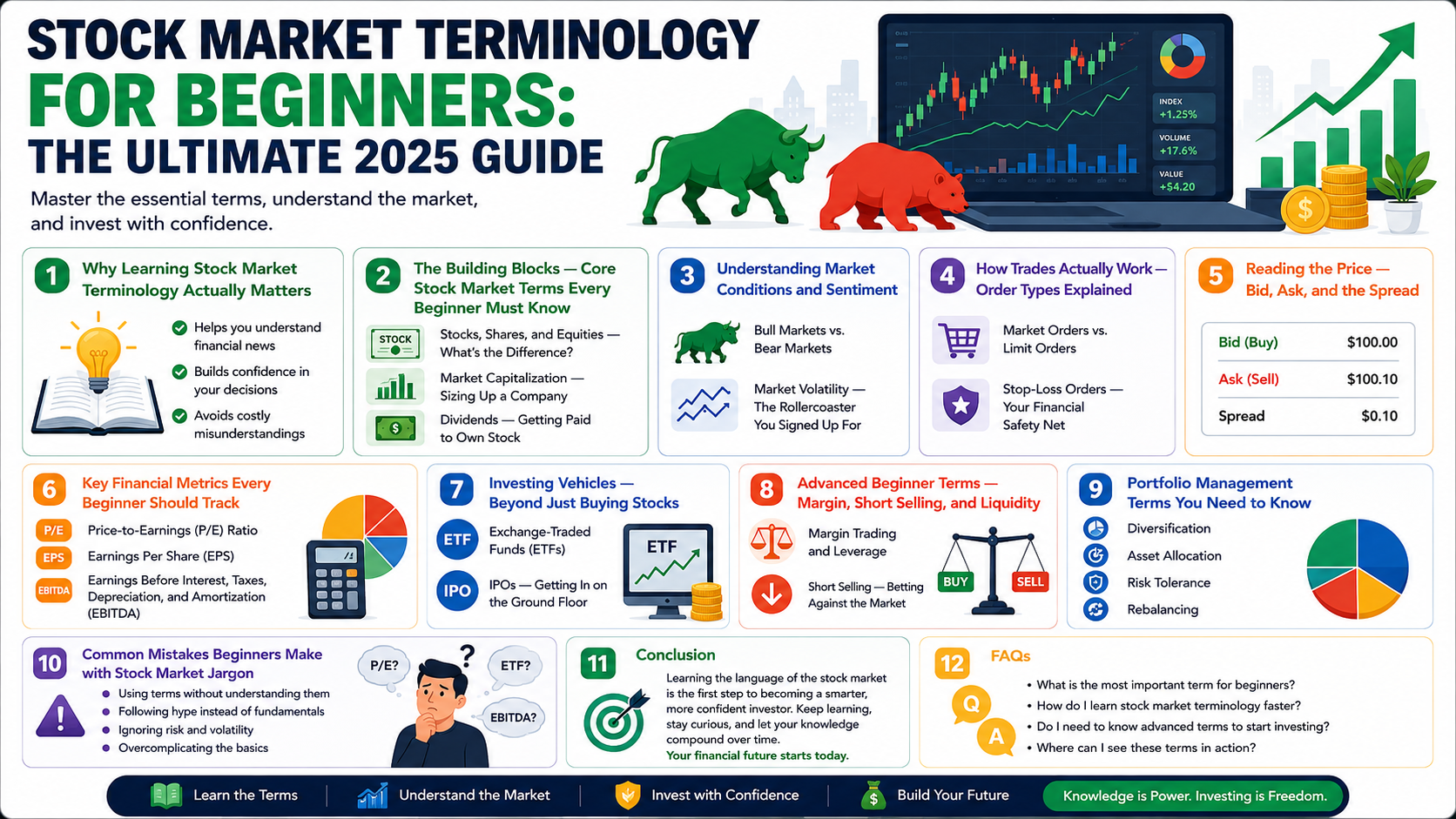
Stock Market Terminology for Beginners: The Ultimate 2025 Guide
You have decided to try the stock market. That is great. Then you look at a financial news site, and it is like reading a different language. The stock market is going up. People are talking about the S&P 500 and short positions and volatility and bid-ask spreads. What does all of this mean? Do not worry; you are not the one who does not know what this means. You are not far behind as you think you are. The stock market is like a language, and you need to learn the basics first. Learning what all the stock market words mean is the step to understanding the stock market. It is like learning the letters of the alphabet before you can write a book. Once you know what the stock market words mean, everything else will start to make sense. That is a great feeling. The stock market can be confusing. Learning the stock market terminology is the key to understanding it. The stock market is not as hard to understand as you think it is. You can learn the stock market. It will be worth it. The stock market is a part of being financially independent, and that is a great goal to have.
The stock market is not something that’s only for people who work on Wall Street and wear nice suits. The stock market is a place where people buy and sell parts of companies. This happens every day. A lot of people. Sell parts of companies on the stock market. The way people talk about the stock market has changed over time. It can seem scary. It is actually pretty simple. The stock market is based on some ideas and words that anyone can learn.
This guide is going to explain the stock market in a way that’s easy to understand. We will use language to talk about the stock market. By the time you finish reading this guide, you will know enough about the stock market to talk about it with people. You will also know how to make decisions about your own money when it comes to the stock market and investing in the stock market.
Why Learning Stock Market Terminology Actually Matters
The biggest risk that new investors face is not a market crash. It is when new investors do not understand what new investors are doing and why new investors are doing it. Understanding the stock market is very important for investors because it helps new investors make better decisions when new investors are investing in the stock market. It also helps new investors talk to brokers and advisors in a way. The stock market is a lot easier to understand when new investors know what the stock market terms mean. This helps reduce the risk for investors because new investors can understand what is going on in the stock market before new investors invest their money. This is a deal. When new investors jump into the stock market without knowing what is going on, it is like trying to drive a car without knowing what the dashboard lights mean. New investors can do it. It is very dangerous, and it causes a lot of stress for new investors. EBC Financial Group
Let us think about this in a way. Every job has its way of talking. Doctors talk about what’s wrong with people and what might happen to them. Lawyers talk about what people can do if someone hurts them and who is responsible. Engineers talk about how strong things are and how much they can take. Investing is the same. The words people use when they talk about the stock market are important because they explain how people buy and sell things, how prices are decided, how people make money, and how people deal with risk. These words cover things like owning parts of companies and getting paid for owning those parts and harder things like special orders to buy or sell the difference between what people are willing to pay and sell for, how big a company is, and when people bet against a company. If people do not know these words, two people can look at the thing happening in the stock market and have completely different ideas about what it means. Knowing the language of the stock market puts the stock market in a way that is not confusing. The stock market terminology is very important. It is like a tool that helps people understand the stock market. Without this tool people can get confused. The stock market terminology helps people make sense of things like shares and dividends. It also helps people understand things, like limit orders and bid-ask spread. The stock market terminology is what explains how things work in the stock market. It is what helps people understand market capitalization and short interest. The stock market terminology is very useful. It helps people who invest in the stock market. EBC Financial Group
What’s more, understanding stock market terms is really important for every trader. It does not matter if you are doing day trading, swing trading, or investing for a time. Knowing stock market terms like “asset class,” “dividend reinvestment plan,” or “market capitalization” is very useful. It helps you make decisions, look at market trends, and manage risk in a better way. The goal of this guide is to help you understand stock market terms so you can move from feeling confused by news to actually understanding stock market terms and doing something about it. Understanding stock market terms is the key to making decisions about your money and the stock market.69+StocksToTrade
The Building Blocks — Core Stock Market Terms Every Beginner Must Know
Stocks, Shares, and Equities — What’s the Difference?
Let us start at the beginning because people get the terms “stock,” “share,” and “equity” mixed up all the time. A stock is something that shows you own a part of a company. When a company needs money and does not want to borrow it, they can break the company into parts and sell these parts to people. Each part is called a share. So when you buy stock in a company, you are buying shares. You are becoming an owner of that company even if it is a small part.
The term “equity” is a word that means owning something. It means the value of owning a part of a company or something else. So stock, share, and equity all mean the same thing: you own a part of something. You own a piece of the company, which’s like owning a piece of a pie. Stocks, shares, and equities are about owning a part of a company.
So why is this important? It is important because when the company does well. When it makes money, gets bigger, or comes out with a new product that people want. The stock you own is worth more money. This is the reason that people can make money with stocks. When you buy a stock you become a part of the company. You might get some of the money the company makes or you might get to help make decisions. Stocks are a part of most people’s investments.
There is another side to this. If the company does poorly, the stock you own is not worth much money. This is the idea that you might lose money if you invest in something that does not do well. Every person who wants to invest in the stock market needs to understand this before they put any money in. Dar-Care
Market Capitalization — Sizing Up a Company
Market capitalization is what people in the finance world call market cap. It is a useful number when you want to know about a stock. This number is the value of a company on the market. You get this number by multiplying the price of one share by the number of shares that are available. For example, if a company has 10 million shares and each share is worth $50, then the market capitalization of this company is $500 million. This tells you how big or how small a company is. People usually put companies into groups based on their market capitalization. There are companies that are worth over $10 billion, medium companies that are worth between $2 billion and $10 billion, and small companies that are worth less than $2 billion. Each group has its risks and chances to grow. Market capitalization is a thing to consider when looking at companies and their market capitalization. Gotrade
When you are just starting out, you might wonder why market cap is important. The reason is that it helps you know what to expect. Big companies like Apple or Microsoft are usually very stable. They do not grow as fast. This makes them a good choice for people who do not like to take a lot of risks. On the other hand, small companies can become very valuable very quickly, but they can also lose all their value just as fast. Knowing about market cap helps you pick the companies for your needs. You can use it to build a group of investments that’s right for you based on how much risk you are willing to take, how long you have to invest, and what you want to achieve with your money. Market cap is one of the things that experienced investors look at when they are deciding which stocks to buy. Now you can use it to make choices too just like they do.
Dividends — Getting Paid to Own Stock
People who are new to this are often surprised by one thing: you do not have to sell your stock to get money from it. Some companies give their shareholders money on a basis, and this is called a dividend. A dividend is money that a company makes, and it gives some of this money to the people who own shares in the company. The company can give you this money. It can give you more shares in the company.
If you own stock in a company, for example, you own 100 shares of a company that pays one dollar and fifty cents per share every year, then you will get one hundred and fifty dollars every year just because you own those shares. This is a thing. The company is giving you money. You do not have to do anything except own the stock. The dividend is a way for companies to give money to the people who own shares in the company. Gotrade
Dividends are really important for people who invest in the stock market and want to make money without doing work. They are especially popular with people who are retired and investors who want to make money for a time. The dividend yield is a way to figure out how much money you can make from a stock, and it is calculated by dividing the dividend by the current price of the stock. This makes it easy to compare stocks and see which ones are the best. Companies that always pay dividends and increase the amount of money they pay over time are considered to be good investments. These companies are called dividend growth stocks. They are good because they show that the company is healthy and the people in charge are confident. Warren Buffett, who is one of the investors in the world, says that dividends are a great way to make a lot of money over time if you reinvest them. Dividends are a part of his investment strategy, and he thinks they are very important for building wealth. Dividend growth stocks like these are really good for people who want to make money for a time.
Understanding Market Conditions and Sentiment
Bull Markets vs. Bear Markets
You have probably heard the term “bull market.” Bear market together. A bull market is when stock prices go up all the time. This happens when investors are happy the economy is doing well and people are putting money into the markets. A bull market is a time when stock prices keep going up. This is usually because investors are confident companies are making money and the economy is growing. It is like a spring day when everything seems okay. A bear market is the opposite. It happens when things are not good. A bear market is when stock prices fall a lot more than 20 percent over a long time. This is when investors are not happy; they are not sure what will happen. They do not want to invest as much. Dar-CareDar-Care
Why do we talk about a bull and a bear when we discuss markets? The reason is actually pretty simple. A bull attacks by thrusting its horns up, and a bear swipes its paw down. This is like the markets going down. When you are just starting out, it is really important to know what kind of market you are dealing with. This will help you figure out what to do. If you are in a bull market, it might be an idea to buy a lot of things. If you are in a bear market, you should be careful and have a good plan. The main thing to remember is that markets do not stay the same forever. Sometimes we have a bull market. Sometimes we have a bear market. The bull and bear markets always switch back and forth. So it is helpful to know which one we are in now. This way you can make decisions instead of just doing things because you feel like it. You can make decisions based on what’s actually happening with the bull market or the bear market.
Market Volatility — The Rollercoaster You Signed Up For
Volatility is a term that people talk about a lot when they discuss news. It is about how much the price of a stock goes down and how fast it happens. Stocks that are very volatile have changes in their prices in a short time. For example, a stock that goes up by 5 percent one day and then goes down by 7 percent the next day is very volatile. On the other hand, a stock that only changes by a small amount each day is considered to be low in volatility or stable.
Neither type of stock is good or bad. It really depends on how you like to invest and how much risk you are willing to take. Some people who trade stocks every day love volatility because it gives them chances to make money from price changes. People who invest for a time, however, often like stocks with lower volatility because they want their money to grow slowly and steadily over time without a lot of ups and downs. Volatility is a thing to think about when you are investing in stocks, like this. Gotrade
The VIX, which is also known as the CBOE Volatility Index, is something people often call the fear gauge of the market. This thing, the VIX, measures what people think the market will do in the future. It does this by looking at the prices of options. When the VIX goes up, it usually means that investors are getting nervous. The VIX and volatility are not things for people who are new to investing. What is bad is when people do not understand the VIX and volatility. If you know that the VIX and volatility are normal things that happen in markets, you will be less likely to sell your investments at the wrong time. Selling at the time is a big mistake that many new investors make. The VIX is like a gauge that tells us how people are feeling about the market. When the VIX is high, it means people are worried. If you understand the VIX and volatility, you will not be as worried. You will know that the VIX and volatility are just part of how markets work.
How Trades Actually Work — Order Types Explained
Market Orders vs. Limit Orders
When you want to buy or sell a stock, you do not just say “buy.” You tell your broker what you want to do. The way you place your order is important. You can use something called a market order. This is the way to do it. You are telling your broker to buy or sell the stock now at the price it’s at that moment. It happens fast. You do not get to choose the exact price you pay or get for the stock. This is okay for stocks that a lot of people are buying and selling. For stocks that are not as popular and do not have as many people buying and selling them, a market order can be a problem. You might end up paying a lot more for the stock than you thought you would, or you might get a lot less money for the stock than you thought you would.
When you use a limit order, you are in charge. You decide the price you want to pay for something or the price you want to sell it for. The order will only happen if the market price reaches the price you set. A limit order is when you say you want to buy or sell something at a price or at a better price. For example, if a stock is selling for $52 but you do not want to pay more than $49, you can set a limit order for $49 and wait to see what happens. The order might not happen today or even this week. If the price of the stock goes down to $49, the trade will happen automatically. Limit orders are really good for people who’re new to this because they help you stay calm and think clearly about what price you want to pay. They make you think about what you want instead of just doing something because of how you feel about what is happening in the market. Limit orders give you control over your trades. Help you make smart decisions about your money. XS
Stop-Loss Orders — Your Financial Safety Net
Let us say you buy a stock for one hundred dollars. You are really excited about how well it will do in the future. Then the price of the stock starts to fall. It goes down to ninety-five dollars, then eighty-eight dollars, then eighty dollars. At what point do you decide to sell the stock and stop losing money? This is where your feelings can get in the way and cause problems for people who’re new to buying stocks, and it is where they often lose a lot of money.
A stop-loss order can help with this problem by making the decision for you. A stop loss is a price that you set ahead of time to automatically sell your stock if it falls to that price, which helps to limit the amount of money you lose. You can set the stop loss at, for example, ninety dollars, and if the stock price drops down to ninety dollars, your shares of the stock are automatically sold. You do not have to think about it; you do not have to worry about what to do. You do not have to hope that the price of the stock will go back up. The stock is just. That is it. XS
Stop loss orders are really helpful for people who invest money. A lot of people who’re new to investing do not use them. You can think of a stop-loss order like a seatbelt when you are driving. It does not make the drive more fun. It can save you from getting hurt if something bad happens. People who invest for a living use stop-loss orders because they are disciplined, not because they’re scared.
When you decide how much money you are willing to lose before you invest, you have a plan. You are not just doing things without thinking. This way of thinking can make a difference between someone who is new to investing and can handle bad times in the market and someone who loses all their money. Stop loss orders can really help with this.
Reading the Price — Bid, Ask, and the Spread
When you buy or sell a stock, there are two prices to think about. The bid price and the ask price of the stock. The bid price of the stock is the price someone is willing to pay for the stock, and the ask price of the stock is the lowest price someone is willing to sell the stock for. The difference between the bid price of the stock and the ask price of the stock is called the spread of the stock. For example, if you see a stock trading at “$50.25 / $50.30,” the $50.25 is the bid price of the stock, which is what buyers are willing to pay for the stock, and $50.30 is the ask price of the stock, which is what sellers want for the stock. If you want to buy the stock, you will pay the ask price of the stock. If you want to sell the stock, you will get the bid price of the stock. Gotrade
The spread is not something you should ignore. It is actually very important. For companies like Apple or Amazon that have a lot of people buying and selling their stocks every day, the spread is usually very small, just one cent. For smaller companies that do not have as many people trading their stocks, the spread can be really big, several dollars. This means that as soon as you buy the stock, you are already losing money because you paid a higher price when you bought it, and you would get a lower price if you sold it right away. The bid-ask spread is something that smart investors think about when they make decisions about buying and selling stocks, especially when they are buying or selling a lot of stocks or dealing with companies that do not have as many people trading their stocks. Understanding the bid-ask spread helps you know the cost of trading Apple or Amazon stocks or any other stocks.
Key Financial Metrics Every Beginner Should Track
Price-to-Earnings (P/E) Ratio
The price-to-earnings ratio, which people usually call the P/E ratio, is an important number when it comes to figuring out how much a company is worth. You will see the P/E ratio once you know what it means. The price-to-earnings ratio tells you how much people are willing to pay for each dollar that a company earns.
For example, if a company makes $5 per share and its stock is selling for $100, the price-to-earnings ratio is 20. This means people are paying $20 for every $1 the company earns. If the price-to-earnings ratio is high, it might mean people think the company will do well in the future. On the other hand, if the price-to-earnings ratio is low, it could mean the stock is a good deal. Or it could mean the company is having some problems. You have to consider the situation when you look at the price-to-earnings ratio. The price-to-earnings ratio is not a simple number; it is a way to understand what is going on with a company and its stock.
The price-to-earnings ratio is really important when you compare it to companies that do the same thing. Things like the price-to-earnings ratio, earnings per share, and return on equity are very important when you want to know how much a company is worth. If you only look at the price of a stock and do not think about these things, you can make a mistake. This is something that a lot of investors do.
When you want to buy a house, you look at houses in the same area to see if it is a good deal. You should do the thing when you buy stocks. A technology company with a price-to-earnings ratio of 35 might actually be a deal compared to other technology companies. A company that makes things with a price-to-earnings ratio of 35 might be too expensive. The price-to-earnings ratio is important. You have to think about it in the right way. If you can do this, you will be a lot smarter about investing in the stock market. You will think like a real investor who knows what they are doing. The price-to-earnings ratio is a tool, and learning how to use it is a big part of being a good investor. EBC Financial Group
Earnings Per Share (EPS)
Earnings Per Share is what it says: the total profit of a company divided by the total number of shares that are out there, which gives you the profit for each share. Earnings per share is one of the ways used to figure out how profitable a company is. You get this by dividing the profit of the company by the number of shares that are out there. For example, if Company A makes a profit of $10 million and there are 5 million shares, then the earnings per share is $2.00.
Earnings Per Share is important because it helps you compare how profitable companies are even if they are different sizes by looking at it on a per-share basis, which makes it fair to compare a small company to a big one. Charles Schwab
When a company’s earnings per share, or EPS, goes up over quarters, it is usually a good thing. This means the company is making money. If the EPS goes down or if it is not as good as people thought it would be when the company talks about how it did, the price of the stock can go down a lot. This can happen even if the company is still making money overall. The way EPS and stock price are connected is very important to people who invest in the stock market. That is why a lot of people pay attention to what companies say about how they did every quarter.
Earnings Before Interest, Taxes, Depreciation, and Amortization (EBITDA)
“EBITDA” is a phrase, but it is really useful once you know what it means and what it leaves out. EBITDA stands for earnings before interest, taxes, depreciation, and amortization. The goal is to see how well a company is doing with its business by taking out things that can be different from one company to another. Two companies can have different tax problems, different amounts of debt, and different ways of accounting for the things they own. EBITDA helps to clear up all of that and show how much money the company is actually making from its daily work. People like to use EBITDA when they want to compare companies in industries or figure out if a company can really pay back its debt. Charles Schwab
Investing Vehicles — Beyond Just Buying Stocks
Exchange-Traded Funds (ETFs)
Not everyone wants to pick stocks, and that is completely fine. Exchange-traded funds are an alternative. An exchange-traded fund is a type of investment fund that is traded on the stock exchange. It is usually designed to follow the performance of an index. So when you buy one share of an S&P 500 exchange-traded fund, you are buying a part of all 500 companies in that index at the same time.
This is like the saying that says, “Do not put all your money in one place.” It is already taken care of with Exchange-Traded Funds. Exchange-Traded Funds give you the benefit of having different investments, like a mutual fund, and the freedom to buy and sell them like individual stocks during the day. Gotrade
Exchange-traded funds have become really popular in the last few years. This is because they are cheap and you can see what you are getting. They are also very good for building wealth over time. When you buy an exchange-traded fund that follows a group of stocks like the ones on a major stock exchange, it usually costs a lot less money than if you were to buy a mutual fund that has someone picking the stocks for you. If you look at how these funds have done over the years, you will see that most of the time the mutual funds do not do better than the group of stocks they are trying to beat. So if you are new to all of this, starting with an exchange-traded fund that covers a lot of different types of stocks can be a great way to begin. This gives you a base to work from, and you can keep learning about how to pick individual stocks.
IPOs — Getting In on the Ground Floor
An Initial Public Offering is the time when a private company sells its shares to the public for the first time. This is the company’s time on the stock market, and it can be very exciting for people who invest in the stock market. The company gets a lot of attention from the media and people who invest. The primary market is when a company sells securities to the public for the first time, usually through an Initial Public Offering. The money the company gets from selling these securities goes directly to the company. After the company sells its shares, people who buy the shares can then sell them to people on the secondary market. Companies do an Initial Public Offering to get money to expand their business, pay off debts, or to give people who invested in the company a chance to get their money back. An Initial Public Offering is a deal for companies, and it can help them grow. Dar-Care
When it comes to Initial Public Offerings, or IPOs, people who’re new to investing should be careful. Sometimes a lot of people get really excited about an IPO, and the price of the shares goes up too much on the first day. Then the price often goes down a lot in the next few weeks or months when people are not so excited anymore. Just because you know what an IPO is does not mean that every IPO is an idea to invest in. A lot of people who’re new to investing make the mistake of getting caught up in the excitement around an IPO. There are examples of big IPOs that did not do well and disappointed the people who invested in them. When you see a new company list its shares, you should look at the company carefully, like you would with any company that has been around for a while. Look at the facts about the company, not just what people are saying about it. EBC Financial Group
Advanced Beginner Terms — Margin, Short Selling, and Liquidity
Margin Trading and Leverage
When you do margin trading, you are basically borrowing money from your broker to buy stocks that you can’t afford with your own money. If you borrow money from your broker to buy stocks, you can make more money, but you can also lose more money. For example, if you have five thousand dollars and you use margin to buy ten thousand dollars of stock, you can make a lot of money if the stock goes up. If the stock goes up by twenty percent, you will have ten thousand dollars, which is double your original money. If the stock goes down by twenty percent, you will lose all your original money, and you will still owe your broker money. This is called leverage. It can be very good or very bad. Leverage is like a power that can help you make more money when things are going well, but it can also hurt you very badly when things are not going well. Margin trading with leverage can be very helpful when the market is doing well. It can be very dangerous when the market is not doing well, especially for people who are just starting out and do not know how to manage the risks. Margin trading and leverage can be a problem for beginners who do not know how to use them properly. Gotrade
Margin trading is when you borrow money from your broker to buy stocks. Most financial experts say that beginners should not do margin trading until they are good at investing with their money. Trading with borrowed money can be very stressful. You can get a margin call, which’s when your broker says you have to put in more money right away or they will sell your stocks and you will lose money. This can be very scary. You should practice investing with your money first and get good at it. Then you can think about using margin trading. The ability to use margin trading will still be there when you are ready for it. Margin trading is not something you should rush into. You have to be careful with margin trading and make sure you know what you are doing.
Short Selling — Betting Against the Market
Short selling is something that a lot of people do not understand when it comes to money. It is actually pretty easy to get. When you do selling, you sell shares that you borrowed from someone else. You do this because you think the price of the shares will go down. Then you can buy the shares back for a price. This means you make money when the price of a stock goes down. Here is how it works. You borrow some shares from the people you work with to buy and sell stocks. You sell these shares for the price they’re worth right now. If the price of the stock does go down, you can buy the shares back for a price. Then you give the shares back to the people you borrowed them from. You keep the extra money. It is like investing but the other way around. Short selling is actually very important for the stock market. The people who do selling help keep things fair. They stop people from getting too excited about a stock. They help show when a company is not worth as much as people think. They also help find companies that are cheating or lying. Short selling is really important for making sure the stock market works properly. Gotrade
The risk of selling is really high. You can lose a lot of money. When you buy a stock, you can only lose what you paid for it. But when you short a stock, the price can keep going up, so your losses can be huge. Short selling is not for everyone, people who are new to this. It is usually considered something that only experienced people should do. It is important to know how it works because short sellers can affect the stocks you own and they can change the way the market behaves in big ways. Short selling is something that you should understand because short sellers can have an impact on the market and the stocks you own.
Portfolio Management Terms You Need to Know
Building a portfolio is where everything comes together. This is when you make a plan that makes sense. There are some things that people who are new to this should know before they start.
Diversification is an idea. It means you do not put all your money in one place. You spread it out across stocks and sectors. This way, if one investment does not do well, it will not hurt your portfolio. Building a portfolio with diversification is like eating foods every day. You do not want to eat the thing all the time.
Asset allocation is also important. It is a decision about how much of your portfolio you want to put in types of investments. These investments can be stocks, bonds, cash, or real estate. You make this decision based on how old you are, how much risk you are willing to take, and what you want to achieve financially. For example, a 25-year-old person might put most of their money in stocks. A 65-year-old person who is close to retiring might do the opposite. They might put most of their money in types of investments. Building a portfolio with the asset allocation is key. Diversification and asset allocation are parts of building a portfolio.
Rebalancing your portfolio is something you need to do from time to time. This means you have to bring your portfolio to the way you originally wanted it to be. For example, let us say you want your portfolio to be made up of 70 percent stocks. Then the market does well, and now you have 85 percent stocks. In this case you would sell some of your stocks. Buy bonds so that your portfolio is balanced again.
Liquidity is also very important. This is about how you can turn an investment into cash without losing a lot of money. It is about how you can buy or sell a stock without changing its price. If a lot of people are buying and selling a stock, it is easy to buy or sell it without affecting the price. This means the stock is very liquid. On the other hand, if a stock is not traded very much, it can be hard to sell it without lowering the price. This is something you need to think about when you’re planning your investments, especially if you might need to get your money back quickly. Understanding liquidity is crucial when you are planning your investment strategy, particularly when it comes to your portfolio and investments like stocks and bonds, and liquidity is something that can affect your portfolio and investments. Gotrade
Common Mistakes Beginners Make with Stock Market Jargon
The stock market can be tough to understand. You can know what all the big words mean. Using them in the right way is a different story. Really smart people who are just starting out can get confused. One big mistake people make is something called FOMO trading. This is when you have a fear of missing out. You hear that it is a bull market, and you want to buy a lot of stocks. You should not buy something just because you hear it is a good time to buy. You need to do some research. Just because it is a bull market does not mean every stock is a choice.
Learning about stock market terms is helpful. It is even more helpful to actually use these terms and see how they work in real life. This is how you can really understand what is going on. Some people try to memorize all the terms. They do not really understand what they mean. This is a mistake.
Another mistake people make is not thinking about the context. For example, you can know what a P/E ratio is. If you do not know what a normal P/E ratio is for a certain kind of company, then you do not really understand what it means. It is like knowing what the word “means” but not knowing if 60 miles per hour is fast for a car or a bike. The stock market is like this. You need to understand the context to get it. Gotrade
Making things too complicated is also a problem. A lot of people who are just starting out get really caught up in learning words and complicated ideas. Like what the Greeks are or what EBITDA multiples are or how technical oscillators work. And they never actually put their money into the stock market. You do not have to be perfect to start investing. It is better to start with the basics and then learn more as you go. Start with the things, like ETFs, and then you can add more complicated things later. The stock market likes it when you are patient and consistent. It does not matter if you are really smart or know secrets that other people do not know. The people who are really good at investing got that way by following rules and doing it for a long time. They did not use plans or big words to get rich. The stock market rewards people who’re patient and consistent, like the legendary investors who built their wealth over time by doing simple things really well.
Conclusion
Learning about the stock market for people who’re new to it is not just about memorizing a lot of big words. It is about learning the basics so you can make decisions about your money. When you learn what each term means, you will be less scared and more sure of yourself. You will know what a bull market and a bear market are. You will know how a limit order can help you so you do not pay much for a stock. You will know why the P/E ratio is important and not the price of the stock. You will know how a stop-loss can help you so you do not lose a lot of money. This is information that you can really use. The stock market is a way to build wealth, and learning about it is the key to using it well. Start with steps and keep learning all the time. Remember that even the best investors started out like you.
The stock market is very powerful. It can help you build wealth. Learning the stock market terminology for beginners is the step. You will learn about the stock market. How it works. You will be able to make decisions about your money. The stock market terminology is not hard to learn. You just need to start small and keep learning.
You now know the difference between a bull market and a bear market. You know how a limit order can help you. You know why the P/E ratio is important. You know how a stop-loss can save your money. This is what you need to know to invest in the stock market. The stock market is not scary when you know what you are doing. Start small. Keep learning about the stock market. You will be glad you did.
FAQs
1. What is the most important stock market term for a complete beginner to learn first?
If you are starting from the beginning, you need to know what a stock and a share are. A stock and a share mean you own a part of a company. When you understand this idea, every other word in the stock market will start to make sense. You will see how everything is connected. It will all build on the idea of a stock and a share. A stock and a share are the foundation of the stock market.
2. What’s the difference between a market order and a limit order?
When you place a market order, it gets done right away at the best price you can get at that moment. On the other hand, a limit order only happens if the market gets to the price you want. For people who’re new to this, limit orders are a good way to go because they give you more say in what happens and help you avoid paying too much for a stock.
3. Is a high P/E ratio always bad?
That is not always true. A high price-to-earnings ratio might mean that people who invest in the company think it will do well in the future. The price-to-earnings ratio is really useful when you compare it to companies that do the same thing or to what the stock has done in the past. You should not look at it by itself.
4. Should beginners try short selling or margin trading?
No, most of the time. Selling and margin trading are tricky and can be really bad for you. You can lose a lot more money than you put in. Most people who help with money say that if you are just starting out, you should stick with things like stocks and ETFs for a while, like a year or two, before you try short selling and margin trading.
5. What’s the easiest way to start investing in the stock market as a complete beginner?
To get started with investing, you should open a brokerage account with a company that’s well known and trusted. It is an idea to begin by putting your money into a type of investment called a diversified index ETF, for example, one that follows the S&P 500. You should add money to your investment account on a regular basis. The key is to think about the term when you are investing. This way of investing is simple. It usually does better than more complicated plans, over time. It also gives you a chance to learn about the market without feeling rushed.