
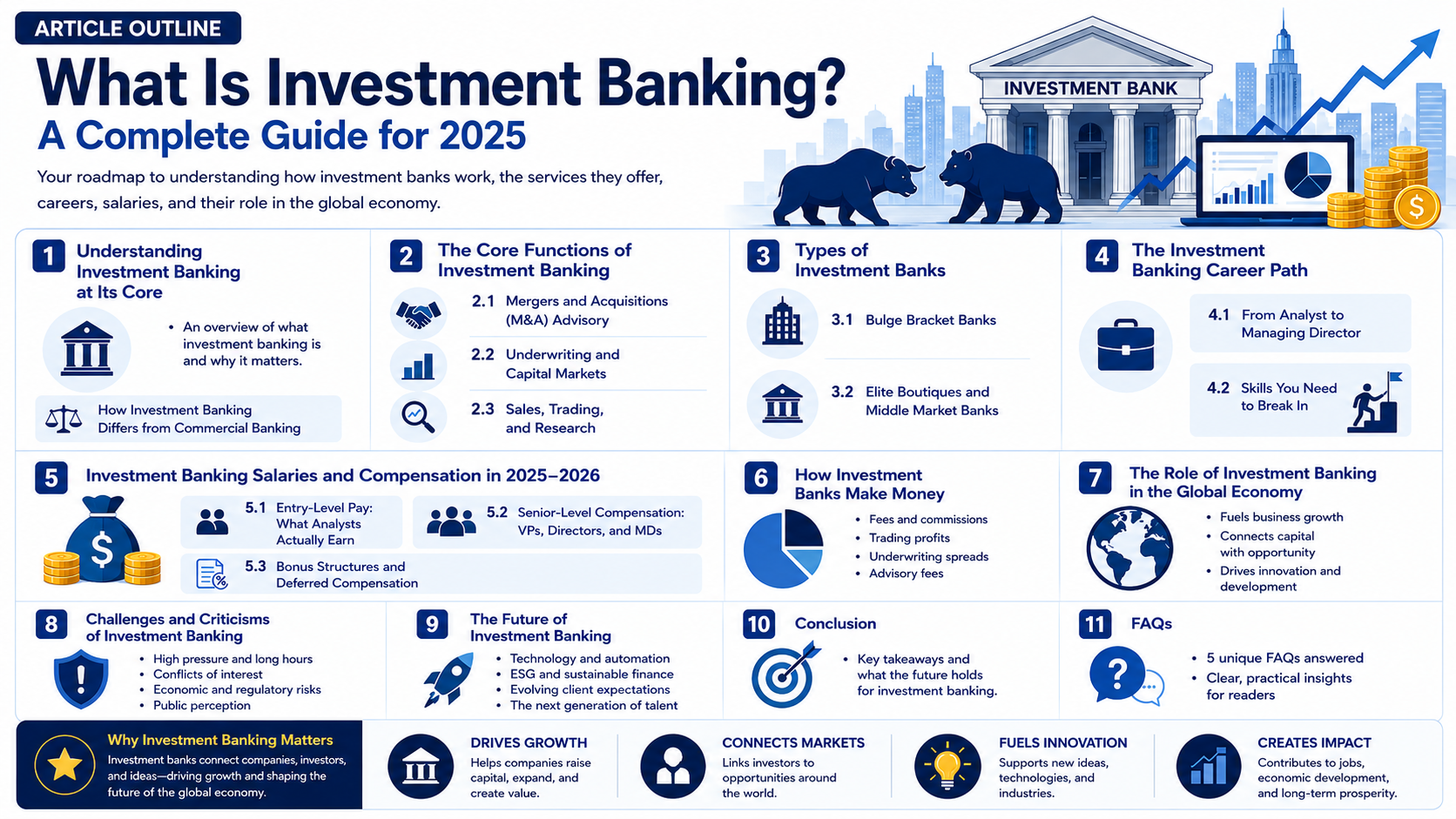
Table of Contents
What Is Investment Banking? A Complete Guide for 2026
If you have ever watched the news and heard about a company merger, a huge initial public offering, or a government getting money through bonds, you have already seen investment banking in action. Even if you did not know it. Investment banking is right in the middle of what companies want to do. The money from all around the world works like an engine that makes some really big financial deals happen. What is investment banking really, and why is it so important? If you are a student who wants to work in finance, a business owner who wants to get some money, or just someone who wants to know how Wall Street works, this guide will explain everything in words. Investment banking is something that you should know about. This guide will help you understand what investment banking is and how it works.
Understanding Investment Banking at Its Core
Investment banking is like a bridge between two worlds: companies that need money and investors who have money to invest. At its core an investment bank is an institution that helps companies, governments, and other groups raise money, do complex financial deals, and make big decisions. It is not like the bank where you do your banking like depositing your paycheck or getting a car loan. Investment banks work with companies, governments, and investors on huge deals that are worth millions or billions of dollars.
The term “investment bank” can be confusing if you think of it like a bank. Investment banks do not usually take money from people. Offer basic accounts. They make money by advising clients, doing deals, and trading on their own. They are like the people who design and build financial deals. They make the plans, put the teams together, and help clients navigate the complex world of global finance. The investment banking industry is very demanding, pays well, and is complex, and understanding it is important if you want to know how economies work. Investment banking is a part of the financial world, and investment banking is what helps companies and governments raise money and make big financial decisions. Investment banking is a part of the financial system, and investment banking plays a big role in shaping the economy.
How Investment Banking Differs from Commercial Banking
This is something that confuses a lot of people, so let us clear up the difference between banks and investment banks once and for all. Commercial banks, like JPMorgan Chase’s division, Bank of America, or your local credit union, take money from people and businesses and lend it out as mortgages, personal loans, and business credit. Commercial banks make money from the difference between the interest they pay to people who put money in the bank and the interest they charge to people who borrow money from them.
Investment banks do something. Investment banks focus on capital markets activities. They help companies raise money by going public; they help businesses buy businesses. They create complex debt instruments, and they help people buy and sell financial securities. A time ago, in 1933, the United States government passed a law called the Glass-Steagall Act, which separated commercial banks and investment banks into two separate groups. This law was passed after the Great Depression. Even though the Glass-Steagall Act is not really a law anymore because it was mostly repealed in 1999, commercial banks and investment banks still do different things. The difference between banking and investment banking is still very clear today. Commercial banks and investment banks have purposes, and they work in different ways. This is a distinction that confuses a lot of people, so let’s clear it up once and for all. Commercial banks — like JPMorgan Chase’s retail division, Bank of America, or your local credit union — take deposits from individuals and businesses and lend money out as mortgages, personal loans, and business credit. They make money on the spread between the interest they pay depositors and the interest they charge borrowers. Investment banks, on the other hand, focus on capital markets activities. They advise companies on going public, help businesses acquire one another, structure complex debt instruments, and facilitate the buying and selling of financial securities. The two types of banking were legally separated in the United States under the Glass-Steagall Act of 1933, following the Great Depression. Though Glass-Steagall was largely repealed in 1999, the fundamental distinction in purpose and operations between investment and commercial banking still holds strong today.
The Core Functions of Investment Banking
Investment banking is not one thing. It is a big category that includes many different investment banking activities. These investment banking activities are all connected to each other. Each one is very important for keeping money moving around the world. When you understand what each of these investment banking activities does, you can see why investment banks are such a part of the way money works today.
Mergers and Acquisitions (M&A) Advisory
Mergers and acquisitions advisory is probably the glamorous and well-known part of investment banking. This is because it involves helping companies make some important decisions. When Company A wants to buy Company B or when two big companies decide to join, investment bankers are the ones who help make the deal happen. They figure out how much the companies are worth, negotiate the terms, and guide both companies through the process of getting everything approved.
Investment bankers who do this kind of work are like skilled doctors. They are called in to do important and difficult work that requires a lot of knowledge and experience. The companies pay these bankers a lot of money for their help. Tens of millions of dollars for big deals. Merger and acquisition work is expected to increase by 15 percent in 2025. Banks like Goldman Sachs and JPMorgan are hiring people to work on this kind of thing, especially in areas like technology, healthcare, and industrials. PrepLounge
Underwriting and Capital Markets
When a company wants to raise money by selling stocks or bonds to the public, it does not just put up an ad on the internet. Wait for people to invest. The company hires an investment bank to help with this process. The investment bank does a lot of things to help the company. It helps the company create the stocks or bonds, figure out how much they should cost, and sell them to investors. Sometimes the investment bank even buys all of the stocks or bonds from the company. Then sells them to the public.
This is an important job for investment banks. It is how companies can become traded corporations by doing something called an initial public offering, or an IPO. The same thing happens when governments need to raise money to build roads or other public things, and they issue bonds. It also happens when companies need to borrow money to grow or buy another company and they issue debt.
The investment bank is like a middleman between the company that needs money and the people who have money to invest. The investment bank gets a fee for helping the company raise money. This fee is a percentage of the amount of money that the company raises.
The job of the investment bank is to balance risk. The bank has to make sure that the stocks or bonds are priced correctly so that investors want to buy them. The bank also has to make sure that the company gets a good deal. This is not a thing to do. The investment bank has to be very careful when it is pricing the stocks or bonds. It has to make sure that the price is fair for both the investors and the company.
Sales, Trading, and Research
Investment banks do a lot more than just give advice and help with underwriting. They also have teams that buy and sell things like stocks, bonds, and currencies for their clients or for themselves. This is a part of what they do. They have to make sure that people can easily buy and sell these things so the market stays active and works well.
The people who do the research are very important. They write reports about different industries, companies, and what is happening in the economy. These reports are very helpful to investors like pension funds and hedge funds. They need information to make smart decisions about where to put their money.
The sales and trading team is about doing deals right now. They help their clients buy and sell stocks and bonds. They make sure that the market keeps moving. Investment banks like to make money by buying and selling things, and sales and trading are a part of that. They have to stay on top of what’s happening in the market all the time so they can help their clients and make good decisions for themselves. PrepLounge
Types of Investment Banks
Investment banks are not all the same. There is an order in the industry, and it is very important to know where each investment bank stands in this order. This matters a lot for companies when they need to choose an advisor. It also matters for investors when they are choosing who they want to work with. It matters for students who are looking for a job at an investment bank. The investment banks have a hierarchy. Knowing this hierarchy is important.
Bulge-bracket Banks
At the top of the investment banking world are the big banks, also known as “bulge bracket banks.” These are the investment banks in the world that everyone knows. Companies like Goldman Sachs, Morgan Stanley, JPMorgan, Bank of America Merrill Lynch, Citigroup, Barclays, Deutsche Bank, and UBS are all bulge bracket banks. These big banks have offices around the world. They have thousands of employees in different countries. They can handle any kind of deal no matter how big or small. They work with the companies in the world. They also get to pick from the people who graduate from top universities. Bulge bracket banks can do about anything when it comes to investment banking. They are, like, stores that can do a little bit of everything; actually, they can do a lot of everything.
Elite Boutiques and Middle-Market Banks
Bulge bracket banks are really big. Some smaller banks like Evercore, Lazard, and Moelis & Company are also very good. They focus on giving advice, especially when it comes to companies buying or selling companies. These smaller banks may not do as many things as the big banks, but they are very good at what they do. People who work at these banks, like Evercore, Lazard, and Moelis, can make a lot of money. On average they get around $494,000 per year. This is because they get a good base salary of $226,000 and a big bonus of over $269,000.
There are also market banks, such as Jefferies, Houlihan Lokey, and William Blair. These banks work with companies that are medium-sized, usually worth between $100 million and $2 billion. They do work that is between the really big deals and the smaller local deals. Each type of bank is different, with its way of doing things, paying people, and helping them advance in their careers. So when you are choosing a bank to work for or work with, you have to think about what you want to achieve. Evercore, Lazard, and Moelis & Company are examples of banks that can help you do this. MNA Community
The Investment Banking Career Path
Investment banking is famous for one thing: it is very demanding. People who work in it get paid a lot of money. This job is about taking big risks to get big rewards. Investment banking is a career in finance where you can start at the bottom as an entry-level analyst and work your way up to become a managing director. The path to get to the top in investment banking is very clear. It is also very competitive. Investment banking is a career, but people like it because they can earn a lot of money. Investment banking is a challenge, but the rewards are big too.
From Analyst to Managing Director
The investment banking career ladder has a lot of steps. It usually starts with the analyst’s job. This is often the job that people get right after they finish college. They do this job for two or three years. During this time they do things like make models and prepare presentations that help make deals happen. After that, people usually move to an associate job. This often happens after they get their MBA. They get promoted. As an associate, they talk to clients more. Manage projects. The next step is vice president. These people are in charge of the teams that make deals happen. They also start building relationships with clients. Above them are the directors, who are also sometimes called senior vice presidents. At the top are the managing directors. These are the people who bring in business, take care of important clients, and make a lot of money for the company. As a managing director, you have to bring in millions of dollars, help decide what the company should do, and be in charge of the company’s important relationships. Managing Directors can make a lot of money. More than one million dollars. PrepLounge
Skills You Need to Break In
So what does it take to have a career in investment banking? To be good at investment banking, you need to have skills that are both about numbers and about working with people. This makes it really tough to get good at it.
On the numbers side, you need to be really good at making models. This means you have to be able to make spreadsheets that show how much money a company will make in the future. You have to be able to figure out how much a company is worth and test what happens if things go wrong. You need to know accounting well so you can look at a company’s finances and understand them quickly. You also need to be comfortable with ideas like figuring out how much money a company will make in the future and using that to decide how much it is worth.
Investment banking jobs usually want people who’re good at making financial models and figuring out how much companies are worth. On the people side, investment banking needs you to be really good at talking to people and working under a lot of stress. You have to be able to make relationships with people, which gets more important as you get older and move up in your job. 365 Financial Analyst
Investment Banking Salaries and Compensation in 2025–2026
Let us talk about numbers. The money people get paid is a deal in investment banking. In 2025 it is not as simple as it seems. Investment banking made a lot of money in 2024. It went up by 30 percent. In the United States it was even higher, going up by 37 percent. The people who work at the banks, the bankers, did not get paid that much more. They got a raise of 10 to 15 percent. This shows something about the industry. When the market is doing well, the banks make a lot more money than they give to the people who are just starting out in investment banking, the junior employees. Jobaaj
Entry-Level Pay: What Analysts Actually Earn
For people who are just starting out as first-year analysts and are new to the industry, the money they can make is really impressive. At the banks in the United States the base salary for first-year analysts is around $105,000 to $110,000 per year. The bonuses that first-year analysts get are usually 65 percent of their base salary. When you add up the salary and the bonuses and the signing bonuses that some banks give a first-year analyst in the United States, they can make around $160,000 to $210,000 per year. This is a lot of money for someone who’s only 22 or 23 years old and has not worked before. To make this kind of money, first-year analysts have to work very long hours, usually 80 to 100 hours, per week. They also have to give up most of their time and deal with a lot of stress because they always have to meet deadlines. People who work on Wall Street say that investment banking does not just pay you for the work you do; it pays you for the time you spend working as a first-year analyst. Private Equity BroPrepLounge
Senior-Level Compensation: VPs, Directors, and MDs
When investment bankers move up the career ladder, their pay goes up in a big way. In the United States, vice presidents get a salary of $200,000 to $210,000, and they also get bonuses that can be as much as 100% to 140% of their base salary. For example, in 2024, 25% of the bonuses that vice presidents got were in the form of stock that they could not sell right away or cash that they would get later over a period of three to five years.
If investment bankers become directors, they can earn a total of $470,000 to $900,000. This includes a salary of $275,000 to $300,000 and bonuses for doing a good job and for bringing in new business, which can be $195,000 to $600,000. Investment bankers who become managing directors can earn a lot of money, from several hundred thousand dollars to more than ten million dollars, if they are really good at their job and work for a top investment banking company.
The average bonus that investment bankers get went up by 25% from 2023 to 2024. It increased from $138,000 in 2023 to $173,000 in 2024, according to information from eFinancialCareers, which is a website that has data about jobs in the financial industry, including investment banking jobs. Private Equity Bro + 2
Bonus Structures and Deferred Compensation
The way investment bankers get paid is more complicated than people think. It is really important to understand how it works if you want to be an investment banker. You get a salary and a bonus at the end of the year. People who have been doing this job for a long time get a lot of their money in other ways. They get something called stock units or phantom equity. They also get money that they cannot use for years.
This system does two things. It makes sure that the banker wants the company to do well in the run. It also makes it hard for them to leave the company. At Deutsche Bank, if you make more than $575,000, you do not get all of your money right away. If you leave the company, you might not get some of your money.
Investment bankers get a lot of their money from. So to get all of your money you have to do a job and stay at the company for a long time. This is like a rule that affects what investment bankers decide to do with their careers. Investment bankers have to think about this when they make decisions about their jobs. The investment bankers have to stay at the company to get all of their money from investment banking. MNA Community
How Investment Banks Make Money
Investment banks do a lot of things. I think it is really interesting to learn about how they make money. Investment banks make money in three ways. First investment banks get paid for giving advice to companies on deals. For example, when companies merge or change the way they are set up, investment banks give them advice. The investment bank gets a fee for doing this. This fee is usually a part of the total deal. This is why big deals are so important to investment banks.
Second investment banks help companies raise money. They do this by selling stocks or bonds for the companies. The investment bank gets a fee for helping them raise money. This fee is usually a part of the total money raised. Third, investment banks make money by buying and selling securities. When clients buy or sell something, the investment bank charges them a fee. Investment banks also make money from the difference between the price they buy something for and the price they sell it for. Some investment banks use their money to invest in the market. However, investment banks do not do this as much as they used to. This is because of rules like the Volcker Rule. These rules were made after the problems, in 2008. Investment banks have to follow these rules.
The Role of Investment Banking in the Global Economy
Investment banking is not about smart people earning a lot of money. It plays a role in the global economy. Investment banks are like helpers that move money around. They take money from people who have extra, like investors. Then they give it to people who need it like companies and governments. This helps the economy work better.
For example, when a pharmaceutical company wants to make a cancer drug, it needs money to do that. An investment bank helps the company get the money it needs by selling stocks. When a country wants to build roads, it can get money from other countries with the help of an investment bank. When two airlines want to join, investment bankers help make that happen.
Investment banks earn a lot of money, $316 billion, every year. The people who help companies merge, called M&A bankers, earn $27.6 billion in fees. That is a lot of money. It shows how important investment banking really is. Investment banking is not a way for people to earn money; it is a big part of how money moves around the world. Investment banking helps decide where investment banking money goes and how investment banking money is used. This makes investment banking a powerful force in the economy. Finsimco
Challenges and Criticisms of Investment Banking
It is not right to talk about investment banking without talking about the problems the industry is facing. Many of these problems are real. We should think about them. The big financial crisis in 2008 had an impact on investment banking. The complicated financial products that investment banks made and sold like mortgage-backed securities and collateralized debt obligations were a part of what caused the crisis. This was an economic problem just like the Great Depression.
Some people do not like investment banking, saying that these banks just want to make money from fees. This can cause problems because the banks’ interests are not the same as the people’s; they are supposed to be helping. Investment banking has also been criticized for how it treats its workers. The hours are very long. It can be bad for the mental health of young analysts. The work environment is very stressful. Can be too much for some people.
In the past few years, big banks have said they will protect the weekends of their analysts and make sure they get enough rest. People who do not like investment banking say that these changes are not really making a difference. They say that the banks are just saying these things to look good and not really changing how they do things. Investment banking is still facing these problems. The investment banking industry has to think about these problems and try to fix them. Investment banking needs to change so it can be better for everyone.
The Future of Investment Banking
The investment banking industry in 2025 is going through a lot of changes. This is because of technology problems between countries and companies competing with each other in many ways. The investment banking industry is changing because of technology. Artificial intelligence is a part of these changes in the investment banking industry. Banks are spending a lot of money on intelligence tools.
These artificial intelligence tools can do tasks that junior analysts used to do, like making models, getting data, reviewing documents, and looking at the market in the investment banking industry.
This does not mean that investment banking jobs are going away in the investment banking industry. It means that the work in the investment banking industry is changing. Now banks want people who can make decisions, be creative, and build relationships in the investment banking industry. Machines cannot do these things in the investment banking industry. People who are good with technology, healthcare, and artificial intelligence are getting paid a lot of money in the investment banking industry. Banks want to hire these people and are paying them well to work in the investment banking industry.
There have been a lot of mergers and acquisitions in 2024 and 2025. In some places the number of deals went up by 20%, 30%, or 50%. However, some analysts think that some of these deals might not work out in the investment banking industry. This could be because of problems with rules, competition, or issues between countries in the investment banking industry. The investment banking industry is very exciting now. It is also very uncertain. People who can deal with uncertainty and think carefully will do well in the investment banking industry. The investment banking industry is. People need to be able to navigate these changes to succeed in the investment banking industry. HedgeThink Mergers & Acquisitions
Conclusion
Investment banking is something that happens behind the scenes. It affects the economy in a big way. It is involved in things like offerings, which help small companies become big public companies, and mergers and acquisitions, which can change entire industries. Investment banking also helps with bond issuances, which pay for things like roads and bridges in a country. The people who work in investment banking are like the ones who create the markets.
To work in investment banking, you need to be really dedicated and really smart. You also need to be able to handle a lot of stress. Investment banking people can earn a lot of money. They also have to make big sacrifices.
If you want to work in investment banking. If you just want to learn more about investment banking or if you are a business owner or investor who deals with investment banking, it is good to know what investment banking is. Knowing how investment banking works helps you understand the world. In a world where money’s everything, it is very useful to have this knowledge. Investment banking is really important, so it is good to know about investment banking.
Frequently Asked Questions (FAQs)
1. What is the main purpose of investment banking?
The main purpose of investment banking is to help companies or governments get the money they need from investors. Investment banking is like a man between these companies and the people who have money to invest. Investment banks also give advice to clients on deals like when one company buys another company or when they need to change the way they are set up. This helps companies make choices about money that can affect them for a very long time. Investment banking is really important for companies because it helps them make decisions about their money and their future. Investment banking is about helping companies and investors work together.
2. Is investment banking the same as Wall Street?
“Wall Street” is often called a shortcut to talk about all of U.S. finances. Investment banking is actually a smaller part of it. Wall Street includes things like hedge funds, private equity, managing assets, regular banking, and more. Investment banking is a job in this area. It helps corporations and big institutions raise money, gives them advice, and trades securities. The focus is on capital raising, advisory services, and securities trading for these clients. Wall Street and investment banking are related but distinct. Investment banking is a part of Wall Street. Wall Street is a world that includes investment banking.
3. How long does it take to become an investment banker?
Most investment bankers enter the field of investment banking right after they finish their undergraduate degree in finance or economics or something similar to that. The path from being an entry-level analyst to becoming a managing director usually takes a long time, like 15 to 20 years. People who do really well can move up the ladder faster. A lot of these professionals also go back to school to get their MBA degrees after working as analysts for two or three years. This can help them become associates and even move up to higher positions in investment banking.
4. Do investment bankers actually work 100 hours a week?
The answer is yes; this happens a lot for junior analysts and associates. Big banks have made rules to keep weekends free and make sure people get rest. The thing is, banking work is all about making deals happen, and that means working with the client’s schedule, market timing, and government rules, which can be really unpredictable. So people often work long hours like 80 to 100 hours a week when there are a lot of deals going on. Senior bankers usually have a bit to say in their own schedules, but they still have to work really hard to keep their clients happy, and that is always a big deal for them, the senior bankers, and their clients.
5. What is the difference between investment banking and private equity?
Investment banking and private equity are two things. Investment bankers help people with transactions. Get paid for it. They are like helpers. Private equity people actually buy companies. Own them. They use money from investors and loans to buy businesses. Then they make these businesses better over years and sell them to make money. A lot of investment bankers start working in equity later in their careers. They think it is the logical step because they can make money from the deals they used to just give advice on. Investment banking and private equity are connected in this way. Many people move from investment banking to equity because they want to be part of the profit from the deals they worked on.