
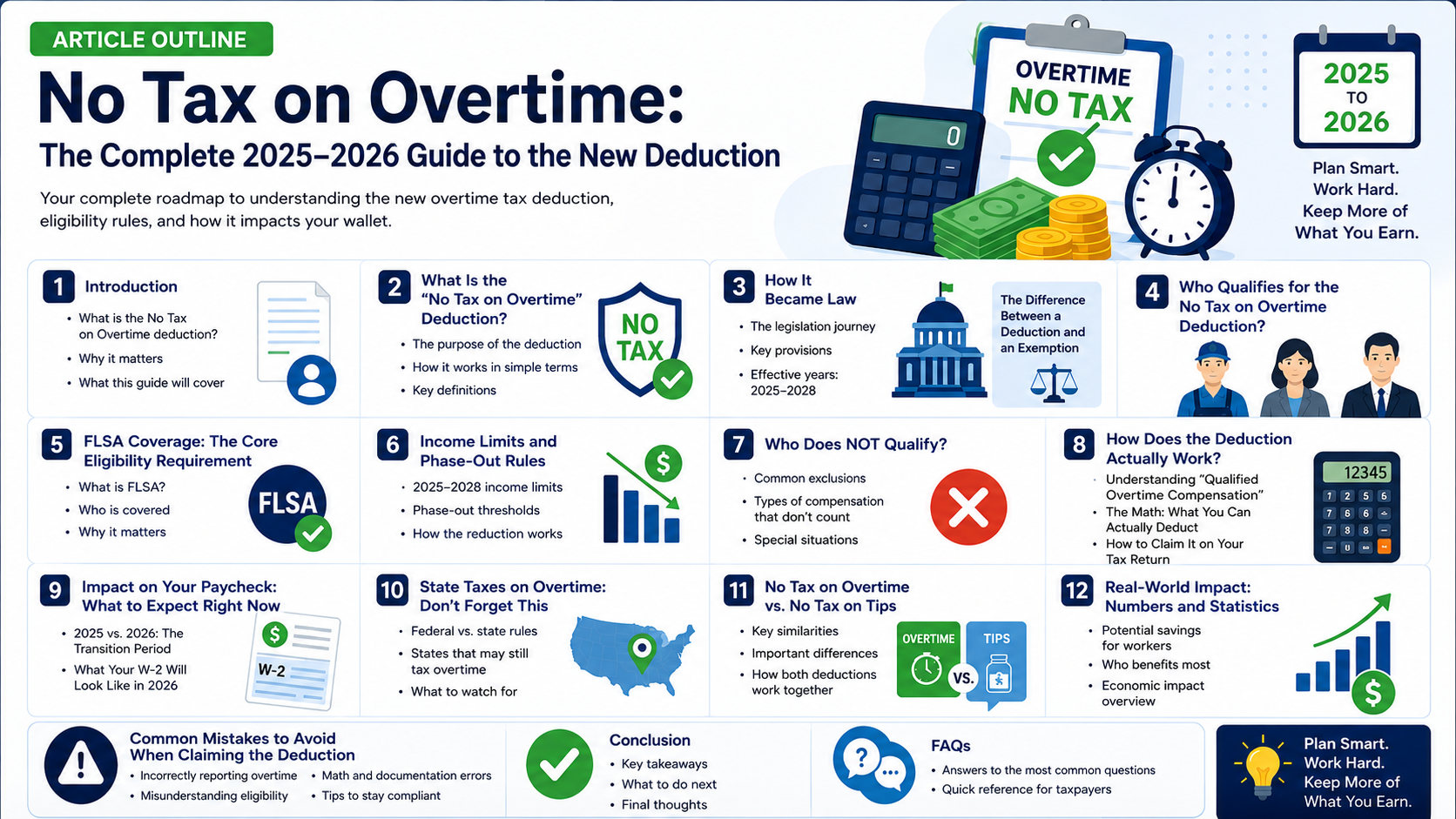
Table of Contents
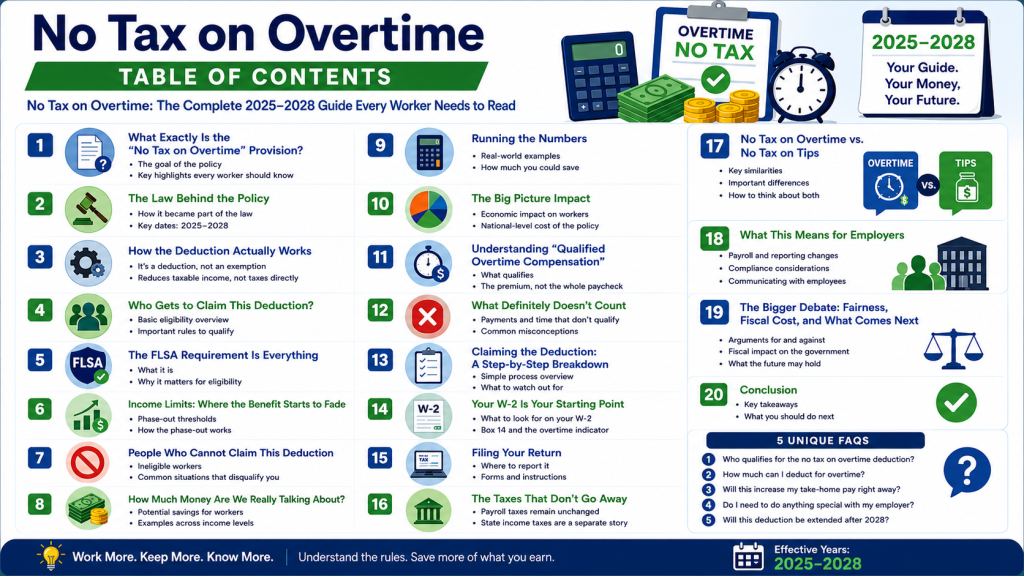
No Tax on Overtime: The Complete 2025–2028 Guide Every Worker Needs to Read
Imagine you work every day for a month and you finally get a big paycheck. Then you see a lot of that money go to taxes. This is what happened to people who worked overtime in America for a time. You work hours. The government takes some of that money just like it does with every other dollar you make. Something changed in the summer of 2025. If you work than 40 hours a week you need to know what that change means for your money from No Tax on Overtime.
A new tax law was signed on July 4 2025. This law has a part called No Tax on Overtime. No Tax on Overtime is one of the talked-about tax changes for working people in America. A lot of people have already used No Tax on Overtime on their 2025 taxes. They got money back than last year from No Tax on Overtime.. Here is the thing: the name No Tax on Overtime is a little wrong. No Tax on Overtime does not get rid of all taxes on your overtime pay from No Tax on Overtime. If you do not understand the details of No Tax on Overtime you could lose money. You could do your taxes wrong.
So let us go through everything you need to know about No Tax on Overtime. We will talk about how No Tax on Overtime works who can use No Tax on Overtime how money you can save from No Tax on Overtime and what to do when it is time to do your taxes with No Tax on Overtime. We will look at the details of No Tax on Overtime so you can understand No Tax, on Overtime. You can use No Tax on Overtime to your advantage.
What Exactly Is the “No Tax on Overtime” Provision?
The Law Behind the Policy
This law did not just appear out of air. It is part of the One Big Beautiful Bill Act, which is officially known as US Public Law 119-21. President Trump signed the One Big Beautiful Bill Act into law on Independence Day in 2025. The One Big Beautiful Bill Act made some changes to taxes it extended tax cuts and it gave new tax breaks to people who get tips senior citizens and people who pay car loan interest.
The part of the law about overtime was created to help people who work hourly and do not make a lot of money like the people who build things deliver things take care of people and keep the country running. Think about people like construction workers who work fifty hours a week nurses who work shifts at hospitals that do not have staff and warehouse employees who work really hard during the holiday season. These workers have been saying for a time that the tax system is not fair to people who work long hours. The One Big Beautiful Bill Act is a way of saying that these workers are right the One Big Beautiful Bill Act is a way to make things fairer for them.
The tax deduction starts on January 1 2025. It goes until December 31 2028. So workers who are eligible for the One Big Beautiful Bill Act have four years to use this tax deduction when they file their taxes for the One Big Beautiful Bill Act. We do not know if Congress will keep the One Big Beautiful Bill Act after 2028. For now workers can use the One Big Beautiful Bill Act and really save some money. The One Big Beautiful Bill Act and the overtime provision are news, for hourly workers and lower-salaried employees who will benefit from the One Big Beautiful Bill Act.
How the Deduction Actually Works
The name of the No Tax on Overtime law can be a bit confusing. The No Tax on Overtime law makes it sound like you do not have to pay taxes on the money you get for working overtime.. That is not what the No Tax on Overtime law means.
The No Tax on Overtime law actually lets you deduct a part of your overtime pay from your income taxes.
The part of your overtime pay that you can deduct from your income taxes is the money your employer has to pay you for working than 40 hours because of the No Tax, on Overtime law.
Think about it like this: when you work overtime, you get one and a half times your pay. Your regular pay is still taxed like normal. The extra half, which is like a bonus, is what you can deduct from your taxes. You can subtract this bonus amount from the money that is taxed when you do your income taxes.
This deduction is available to everyone whether you list all your deductions or take the deduction. This is a deal because most people who do not make a lot of money do not list all their deductions. So this deduction is available to a lot of people. If you are single, you can deduct up to $12,500 of the overtime money you get. If you are married and file your taxes together, you can deduct up to $25,000 of overtime pay.
Who Gets to Claim This Deduction?
The FLSA Requirement Is Everything
The important thing to know about eligibility is that your overtime must be governed by the Fair Labor Standards Act. This is a law that says most employers must pay workers who are not exempt at least 1.5 times their regular rate for any hours worked over 40 in a workweek. If your overtime is covered and required by the Fair Labor Standards Act, then you might qualify for this deduction.
The term “non-exempt” is key here. Under the Fair Labor Standards Act, some workers are classified as exempt. This means the overtime rules do not apply to them. These exempt workers are usually executives, high-level managers, administrators, and professionals who earn a salary. If you are one of these workers, then the deduction does not apply to you no matter how many extra hours you work.
The Fair Labor Standards Act was made this way on purpose. It is meant to help workers who are legally entitled to overtime pay. It does not help those who choose to work and are paid a salary. The Fair Labor Standards Act and overtime pay are for workers who need it.
Income Limits: Where the Benefit Starts to Fade
So your overtime has to qualify under the Fair Labor Standards Act. The amount of money you make in total decides how much of a deduction you can really get. The benefit starts to go away when your modified adjusted gross income is more than $150,000 for single people or $300,000 for married couples who file taxes together. When you make more than those amounts, the deduction gets smaller and smaller until it is gone.
This is how it is supposed to work. The people who make the rules wanted this benefit to help people who are working class and middle-income. Not people who make a lot of money and just happen to work hours. If you make a lot more than those income limits, you might not get any overtime deduction at all. If you make between $40,000 and $120,000 and you work overtime a lot, then this deduction is really for people like you, for people who work overtime, for overtime workers who need some extra help with their taxes.
People Who Cannot Claim This Deduction
It’s equally important to know who is not eligible. Independent contractors and gig workers do not qualify. You must be a W-2 employee. People who file as married filing separately are excluded.
Your Social Security number must be valid for employment. Issued before the tax returns’ due date.
Any overtime that your employer pays voluntarily beyond what the law requires does not count. Overtime required by your state’s law or a union contract also does not count.
This often surprises workers in states like California, which have overtime rules. In California you get overtime pay for working more than 8 hours a day. This extra overtime does not count toward the deduction. Only the overtime pay required by law qualifies. The federal deduction only counts overtime pay that is mandated by law, not state law or union contracts.
How Much Money Are We Really Talking About?
Running the Numbers
Let us make this real with some numbers. Suppose you are a person who earns forty-five thousand dollars per year in regular pay and over the year you get eight thousand dollars in total overtime pay. The extra amount you get for overtime, which is half of your time and a half pay, might be two thousand six hundred dollars. This is the amount you would subtract from the income that is taxed. Depending on the tax rate you pay to the government, which is probably twenty-two percent at your income level, you would save around five hundred seventy dollars in federal income taxes just from this subtraction.
Now let us think about this on a scale. A worker who earns fifty-five thousand dollars per year and gets overtime, say six thousand dollars in overtime premium pay, could save one thousand three hundred twenty dollars or more. For workers who really work hard fifty or fifty-five hours every week and whose annual overtime premium is close to the twelve thousand five hundred dollar limit, the maximum tax savings, at a twenty-two percent rate, would be around two thousand seven hundred fifty dollars. This is money that used to go to the federal government, and now it stays in your pocket.
The Big Picture Impact
The numbers are really big when you look at the country. The Treasury has some data that shows 63.5 million tax returns were filed by early March this year. Of those people, more than 15.5 million claimed the No Tax on Overtime deduction. This makes it the most popular of all the tax cuts that were introduced.
The no-tax-on-overtime deduction is a deal. Average tax refunds are more than 10% higher than they were last year. The no-tax-on-overtime deduction is a reason for this.
From the government’s point of view, the no tax on overtime deduction is expensive. The Joint Committee on Taxation thinks it will cost 89 billion dollars over 10 years if it ends in 2028 like it is supposed to. That is 89 billion dollars in tax money that the government will not get. Instead, the government is giving this money back to working Americans who work hours. Whether or not this is an idea depends on what you think about politics. But one thing is for sure: the no tax on overtime deduction is putting money in workers’ bank accounts right now.
Understanding “Qualified Overtime Compensation”
The Premium, Not the Whole Paycheck
This is the part that people have trouble with so lets take a look. When you work overtime your overtime paycheck has two parts: the part, which is what you would normally earn and the extra part, which is the additional money that the law says your employer has to pay you. Only the extra part can be used for this deduction.
Lets say you get paid twenty dollars an hour. You work ten hours of overtime this week. You get paid thirty dollars for each overtime hour, which’s a total of three hundred dollars.. If you were working regular hours you would have earned two hundred dollars for those ten hours. The extra one hundred dollars is the part that might be able to be deducted. Not the whole three hundred dollars. The government still wants the taxes on the two hundred dollars that you would have earned anyway. They are only giving you a break on the one hundred dollars that you got for working more, than forty hours.
What Definitely Doesn’t Count
There are categories of overtime pay that are not included in this deduction. Knowing what they are can help you avoid mistakes when you do your return. If you have to work overtime because of a state law, this does not count. If you get overtime pay because of a union agreement and not because a federal law says you have to, then this does not count either. If your employer pays you overtime just because they want to or because it is their company policy, then this does not count. You also cannot include tips you get when you work overtime in this deduction, although you might be able to include them in a deduction called “No Tax on Tips.”
Claiming the Deduction: A Step-by-Step Breakdown
Your W-2 Is Your Starting Point
Your employer is in charge of figuring out and telling the government about your overtime premium pay. For the 2025 tax year, a lot of employers put this number in Box 14 of your W-2. They might have called it something like “FLSA OT Prem.” Starting with the 2026 tax year the IRS told employers to use Box 12 with the code “TT” on a W-2 form. This way, the reporting will be easier to understand and more consistent.
If your employer did not put this information on your W-2, do not worry. You can use your records to calculate the premium amount. You can use things like pay stubs, earnings statements, and downloads from your employer’s portal. The IRS knows that 2025 was a year for employers to get everything right. A lot of employers did not have systems in place to track overtime premiums separately. So the IRS gave them some flexibility in how they reported this information for 2025. If your W-2 is missing this information, it is not a deal as long as you have the right documents. You can still use your qualified overtime premium pay records to get everything sorted out.
Filing Your Return
When you sit down to file your taxes, you will work with Schedule 1-A on your Form 1040. You will enter your Modified Adjusted Gross Income in Part I and your qualified overtime compensation in Part III. If you use tax preparation software like TurboTax or H&R Block or FreeTaxUSA, the platform will guide you through these fields after you enter your W-2 information. The software will automatically check if you are eligible for the deduction, apply the income phase-out if you make much money, and calculate your deduction for you.
One thing to keep in mind: this deduction is an above-the-line deduction, but it does not reduce your Modified Adjusted Gross Income. Instead, it reduces your income. This matters because your modified adjusted gross income is used to figure out if you’re eligible for other deductions like Roth IRA contribution limits and certain credits. So if you are close to any of those limits, you should think about this when you plan your taxes.
The Taxes That Don’t Go Away
Payroll Taxes Remain Unchanged
Let us talk straight about something. Social Security and Medicare taxes, also known as FICA, still apply to all your overtime pay, including the amount you get. Your employer takes 7.65 percent of every dollar you earn for Social Security and Medicare taxes, also known as FICA. That does not change with this law. This new law only affects how much federal income tax is taken out, not the Social Security and Medicare taxes, also known as FICA. If you already earn a lot, like near or above the Social Security wage limit, which was $176,100 in 2025, then this does not make a difference. For people who work overtime, Social Security and Medicare taxes, also known as FICA, will still take a normal chunk out of every extra hour they work.
State Income Taxes Are a Separate Story
The federal deduction does not change your state income taxes at all. Each state creates its rules for taxes. If your state has not made its rules similar to the government’s, then you still have to pay state income tax on your full overtime pay, including the extra amount you get for working overtime.
In states like California, New York, or New Jersey, where state income taxes are really high, you will still have to pay a lot of state income taxes on the extra money you earn from working overtime hours. These state income taxes can be as high as 9 percent to 13 percent.
The federal deduction is really helpful for your income taxes. It is one part of the whole tax picture for your federal income taxes and state income taxes. You should always add up all the income taxes and state income taxes you have to pay to figure out how much money you really get to keep from working federal income taxes and state income taxes and overtime hours.
No Tax on Overtime vs. No Tax on Tips
The No Tax on Tips deduction and the No Tax on Overtime deduction were passed together. The No Tax on Tips deduction and the No Tax on Overtime deduction are two things. To understand the No Tax on Tips deduction and the No Tax on Overtime deduction, we need to look at what each of them does.
The No Tax on Tips deduction is for people who work in jobs where they get tips, like servers and bartenders and valets and salon workers and personal trainers. These workers can deduct up to $25,000 in tip income that they got from people. It does not matter if they are single or if they are married. The No Tax on Tips deduction is for the tips they get.
The no tax on overtime deduction is different from the no tax on tips deduction. The No Tax on Overtime deduction has a cap of $12,500 for people who file their taxes alone and $25,000 for people who file their taxes together. The no-tax-on-overtime deduction is also tied to the rules about overtime that are set by the Fair Labor Standards Act. This means that the No Tax on Overtime deduction follows the rules that are already in place for overtime work.
The No Tax on Tips deduction and the No Tax on Overtime deduction do not overlap. This means that when people work overtime and get tips, the tips they get go towards the No Tax on Tips deduction, not the No Tax on Overtime deduction. People who get tips and also get overtime pay could possibly get to use both the No Tax on Tips deduction and the No Tax on Overtime deduction at the time. This could really reduce the amount of income that’s taxable. For example, a worker at a restaurant who gets tips and works more than 40 hours a week is in a really good position because of the no tax on tips deduction and the no tax on overtime deduction. The No Tax on Tips deduction and the No Tax on Overtime deduction can really help people who get tips and work overtime.
What This Means for Employers
Employers are not just standing around doing nothing. They have to do some work when it comes to reporting. Employers need to figure out and tell each employee who’s eligible how much extra money they got for working overtime. Employers have to give each employee the amount of extra money for overtime work. This is something employers have to do for employees who worked overtime. They can do this on the W-2 form on a website or by giving them a paper with the information. Employers should not try to give tax advice. If an employee asks if they will benefit from a deduction, the employer should say, “You should talk to your tax person.”
For the year 2026. After companies need to update their payroll systems. They have to keep track of the overtime money separate from the regular money and the total hours worked overtime. Companies that have not done this yet need to make it a priority before the end of 2026. The IRS is not going to be flexible about this like they were in 2024. Payroll systems need to be ready to track overtime premium pay for 2026 and beyond.
The Bigger Debate: Fairness, Fiscal Cost, and What Comes Next
This policy is not making everyone happy. Some people do not like it because it helps workers who can work hours. This means single parents and people who take care of others are not helped. Also, people who work jobs and those who have disabilities that prevent them from working long hours are not helped.
For example, a worker who has to pick up her kids at 5 PM cannot stay late at work. She does not get any help from this policy even if she needs money as much as her coworker who stays until 8 PM.
People are also wondering if this policy is an idea for the country’s money in the long run. This policy will cost around 89 billion dollars over ten years. That is a lot of money. Some economists think that this policy might make employers want to give workers overtime hours instead of hiring new workers. This could affect how many people have jobs and what benefits they get.
On the other hand, people who like this policy say it is a good thing because it recognizes that working long hours is hard. They also say that giving money to workers helps the area more than other ways of using that money. The argument about this policy will get stronger as 2028 gets closer. Then Congress will have to decide if they want to keep this policy or get rid of it.
Conclusion
The No Tax on Overtime provision is really good for people who work hard with their hands and backs. This is not just for people who have a lot of money invested. It is a change that actually helps people.
The No Tax on Overtime provision is not perfect. It has some rules that limit who can get it. The No Tax on Overtime provision also has a time limit. We do not know if this time limit will be extended or not. For many American workers who work more than 40 hours a week, the No Tax on Overtime provision is a big help. It means they will pay taxes.
If you worked overtime in 2025, you should get this tax deduction. Ask your employer for the amount of overtime pay you got. Check this amount with your pay records to make sure it is correct. Then you can use a computer program to do your taxes. You can ask a tax professional to help you. You can save money on your taxes for four years. The No Tax on Overtime provision can help you, so do not forget to claim it.
5 Unique FAQs
1. Can I claim the No Tax on Overtime deduction if my employer paid me overtime voluntarily, beyond what FLSA requires?
No. The only overtime that counts is the overtime that the Fair Labor Standards Act says is required. If your employer pays you overtime because that is what the company wants to do or because they are being generous or because of a union agreement, then that extra money does not count when you are figuring out your deduction. This is true even if the overtime pay looks the same on your paycheck as the overtime pay that the Fair Labor Standards Act requires. The Fair Labor Standards Act is what matters here, and only overtime that is required by the Fair Labor Standards Act counts.
2. If I worked overtime for two different employers during 2025, can I combine both amounts for the deduction?
You can definitely add up the qualified overtime premium pay from employers as long as each job on its own meets the rules of the Fair Labor Standards Act. The thing to remember is that the total amount you can deduct is still limited to $12,500 for people who file taxes or $25,000 for married couples who file taxes together, and this limit applies to all the money you get from all sources.
3. I’m a salaried employee who sometimes gets overtime — do I qualify?
It depends on what kind of worker you are under the Fair Labor Standards Act. If you are a salaried worker who earns more than thirty-five thousand five hundred sixty-eight dollars per year, you are probably entitled to Fair Labor Standards Act overtime. The Fair Labor Standards Act overtime is for people who work a lot of hours. If you are a salaried worker who is exempt, like a manager or a professional, then you do not get Fair Labor Standards Act overtime even if you work a lot of extra hours. The Fair Labor Standards Act is what determines this.
4. Will claiming this deduction trigger an audit?
Not really. The IRS knows that many workers are claiming this deduction, and it’s a part of the law. As long as your employer reported your overtime correctly and your numbers match your W-2 or other papers, you’re fine. Keeping your pay stubs and earnings statements as records is an idea.
5. Does the No Tax on Overtime deduction affect my eligibility for other tax benefits like the Earned Income Credit or child tax credits?
This tax deduction lowers the amount of money that’s subject to taxes rather than the adjusted gross income. The adjusted gross income is what most tests use to see if you are eligible for things. So this tax deduction does not directly affect those tests that use the adjusted income. However, it can change the amount of taxes you have to pay, and that can affect some tax credits. To really understand how this works for you, you should use tax software to do your tax return, or you should talk to a tax professional. They can show you how everything works together for your taxes.