
Table of Contents
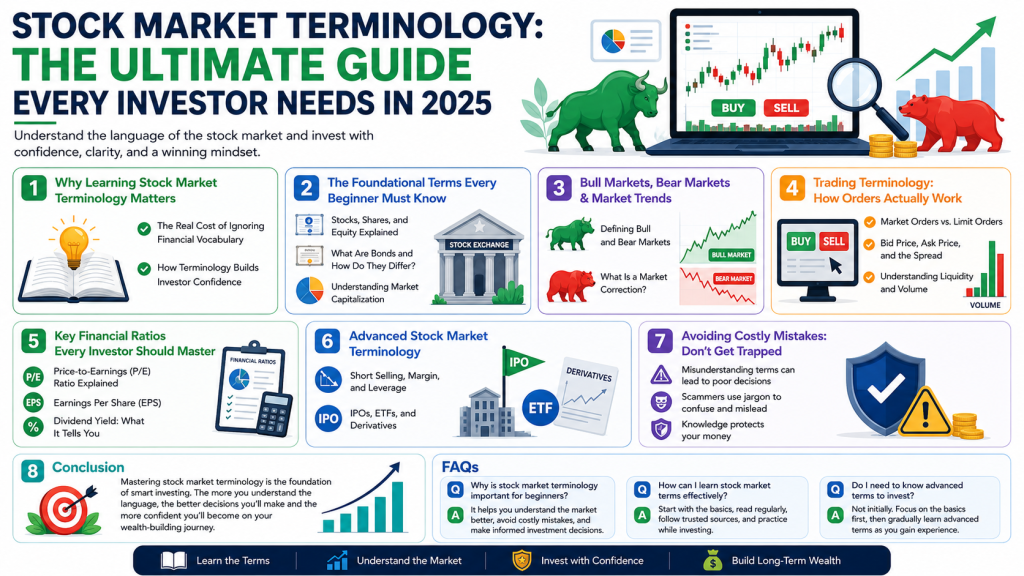
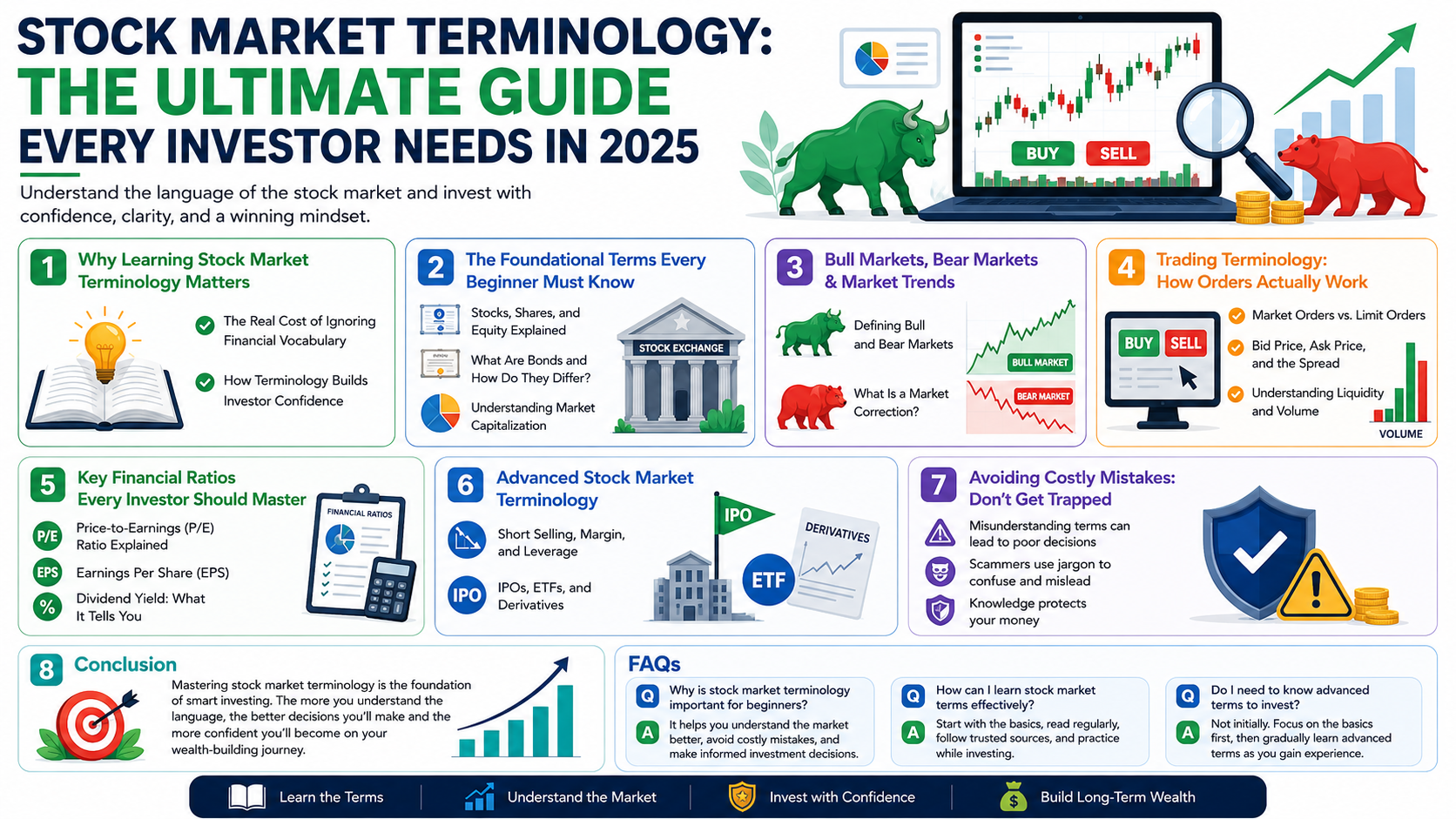
Stock Market Terminology: The Ultimate Guide Every Investor Needs in 2025
If you have ever tried to read a news article and felt like you were trying to understand a language you do not know, then you are not the only one. The stock market has a lot of words and phrases that people who work with money use every day. These words and phrases are not meant to confuse you. They are meant to help people be precise when they talk about money because one wrong word can cost you a lot of money. Learning what these words mean is not just for people who work on Wall Street. It is something that anyone can learn if they want to make money by investing in the stock market.
Think about learning stock market words like learning the rules of a game. You would not try to play a game of chess without knowing what all the pieces are, would you? It is the same with the stock market. You need to know what all the stock market words mean. These words explain how people buy and sell stocks, how prices are decided, how people make money, and how people do not lose money. These words include things like what shares and dividends are and harder things like what limit orders and bid-ask spread are. If you do not know what these words mean, then two people can look at the information and have very different ideas about what it means. This is a problem because it can be the difference between making money and losing money when you invest in the stock market. The stock market is about understanding the stock market terminology, and the stock market terminology is key to making good decisions. The stock market terminology includes things such as market capitalization and short interest, and these are important to know if you want to be good at investing in the stock market. EBC Financial Group
Why Learning Stock Market Terminology Matters
The Real Cost of Ignoring Financial Vocabulary
If you have ever tried to read a news article and felt like you were trying to understand a foreign language, you are definitely not alone. Let us be honest here. Most people do not want to learn terms because it seems very hard. And the market does not make it easy for beginners. Not knowing these financial terms can cost you a lot of money. Some recent studies show that people who understand financial terms get 23% better results than those who do not, and not knowing these terms costs the average person thousands of dollars every year because they miss good opportunities and make bad investment choices. This is not a number. It is a warning that we should pay attention to. Financial terms are important. We should try to understand them. Financial terms can help us make investment choices and get better results. Investurely
When you do not understand the words people use to talk about the market, you will probably make decisions based on how you feel in the moment of thinking ahead. For example, you might hear people on the news talking about a correction. You will sell your stocks because you are scared but you do not really know what a correction is. A correction is when the market goes down by ten percent, which is something that happens many times in a year. You might also see a company’s price-to-earnings ratio, which is often called the P/E ratio. You will not know if it is a good price or if it is too high. You might even miss out on a chance to buy stocks in a company when it first starts selling them, which is called an initial public offering, or an IPO, because you do not know what those letters mean. Not knowing about money. The market can cost you a lot of money over time. It is a consistent expense. The good news is that it is not that hard to learn about money. All you need to do is spend time learning the language of money and the market terminology and the language of money.
How Terminology Builds Investor Confidence
Mastering the words used in the stock market has an impact on your mind. When you talk to your broker or financial advisor about things like portfolio strategies, knowing what the words mean makes a difference. You are not just standing there listening; you are taking part in the conversation. Knowing the stock market vocabulary helps you talk to advisors, brokers, and other people who work with investments. This means you get advice, investment ideas that are right for you, and stronger relationships with these professionals that can help you with your money goals. The stock market vocabulary is important to know when you are talking to your broker or financial advisor about your portfolio strategies and investment plans. Investurely
Investing with confidence is not about having a lot of money. It is about having a lot of knowledge about investing. When you know what investing words like “diversification” and “asset allocation” and “rebalancing” mean, you stop looking for quick ways to make money, and you start making a plan. When you understand what intrinsic value and market price mean, you stop worrying about what is happening right now, and you start thinking about what will happen in the long term. The words people use to talk about the market are like a map of the market. Investing is like going to a city. If you do not know what the investing words mean, it is like trying to find your way around a city without a map or a GPS.
The Foundational Terms Every Beginner Must Know
Stocks, Shares, and Equity Explained
Let us start at the beginning. We should look at things again with our eyes. A stock is a part of a company that you can own. When a company wants to get money to make itself bigger or try new things, it can divide itself into a lot of small parts called “shares.” Then it sells these shares to people. When you buy a share of a company, you become a shareholder. This means you own a part of that company. Because you own a part of the company, you have some rights. You have the right to vote on decisions that the company makes. You also have the right to get some of the money that the company makes, which is called a dividend. You own a part of the company when you buy a stock. The company is divided into shares, and each share is a small part of the company.
Equity is the idea here. When we talk about money, equity is the value of something you own after you pay off any loans you used to buy it. Common stock is a kind of investment that means you own a tiny piece of the company that issued it. If you own stock in a company in the United States, you get to vote on important decisions, like who sits on the board of directors, and you might even get some money.
Preferred stock is different. People who own stock get their money first when the company pays out dividends or sells its assets. Usually they do not get to vote on anything. It is really important to know the difference between these two kinds of stock. Equity and common stock and preferred stock are things that every investor should understand. The Stock Market Game
What Are Bonds and How Do They Differ?
Stocks are like owning a part of a company. Bonds are like debt. When a government or a company needs a lot of money, they do not want to give away part of the company. So they borrow money from people who invest by issuing bonds. When you buy a bond, you are basically lending money to the company that issued the bond. The company promises to pay you on a certain day, which is called the maturity date. They also pay you some money, called interest, at regular times. These are called coupons.
Bonds are a type of investment where you get a fixed amount of money at times. The company that issued the bond has to pay you this money. There are types of bonds like Treasury bonds and corporate bonds and municipal bonds. You also have things, like notes and bills and certificates of deposit. All these are types of bonds. When you invest in bonds, you know how much money you will get and when you will get it. Charles Schwab
Bonds are usually thought to be safer than stocks. This is because you know when you will get your money back. The company has to pay you by a certain time. Bonds do not make as much money as stocks.
The way stocks and bonds work together is very important when you are trying to figure out how to invest your money. Stocks and bonds are, like, the basics of investing. You need to know how they work so you can make choices. Most people who help others with money say you should have some stocks and some bonds. They say this because it depends on how old you are, what you want to do with your money, and how much risk you are willing to take with your money.
Understanding Market Capitalization
Market capitalization is something people talk about a lot when they invest in things.. A lot of people do not really understand what it means. It is actually pretty simple. Market capitalization is the value of a company. You calculate it by multiplying the price of one share of the company by the number of shares that exist. For example if a company has 10 million shares and each share is worth $50 then the market capitalization of the company is $500 million. That is easy to understand.. Market capitalization is more than just a simple math problem. Market capitalization shows the value of a company. People use it to put companies into groups like companies, medium sized companies and small companies. Each of these groups has its risks and rewards. Market capitalization is a thing to consider when you are investing in companies, like these. Market capitalization can help you understand what you are getting into. Gotrade
Big companies like Apple, Microsoft, or Johnson & Johnson are usually very stable. They have been around for a time, and people know what to expect from them. These big companies, which are called large-cap companies, are worth a lot more than $10 billion. Small companies are different. They are worth money and are often younger. These small-cap companies can grow fast, but they are also riskier. There are also sized companies called mid-cap companies. They are right, in the middle. Mid-cap companies can grow. They are also pretty stable. When people talk about investing in companies, small companies, and medium-sized companies, they want to spread their money around. This means they invest in large-cap companies, small-cap companies, and mid-cap companies. They do this so they can make money. Also, so they do not lose too much money if something goes wrong. Investing in all three types of companies helps people balance their risk.
Bull Markets, Bear Markets & Market Trends
Defining Bull and Bear Markets
If you have read any news about money, you have probably seen the words “bull market” and “bear market.” These two ideas are really important when it comes to investing. They affect the way people think about money and what the government does. A bull market is when stock prices go up and people are feeling good about investing. A bull market is a time when stock prices keep going up, and a bear market is a long time when stock prices keep going down, usually when they drop by twenty percent or more from how high they were before. It makes sense to use a bull and a bear to describe this because a bull uses its horns to push up and a bear uses its claws to swipe down. The bull market and the bear market are two things that people talk about a lot when they are talking about the bull market and the bear market. The Stock Market Game
Bull markets can go on for a time, sometimes for many years. When we are in a bull market, the economy is usually doing well, people have jobs, and companies are making a lot of money. The bull market that happened in America from 2009 to 2020 was really something; it lasted for eleven years. This was after the financial problems in 2008.
On the other hand, bear markets are tough times when prices keep going down. These times can be very hard for investors, for people who have been doing it for a long time. Bear markets usually happen when the economy is not doing well, many people are losing their jobs, and companies are not making much money as they used to. It is very important for investors to know what is happening in the market at any given time. Knowing where we are in the market cycle is valuable information for people who invest in the market. Bull markets and bear markets are two different things, and understanding bull markets and bear markets can help investors make good decisions.
What Is a Market Correction?
A market correction is something that people get mixed up with a bear market, but they are really different things. A market correction is when a stock or market index goes down by at least 10 percent but not more than 20 percent from its last high point. Market corrections happen a lot. Are a normal part of how the market works. They stop prices from getting too high and give people who are waiting a chance to buy. A bear market is when share prices go down by at least 20 percent from their last high point, which is the point where it is not just a correction anymore. Market corrections and bear markets are two things that investors need to know about. A market correction is like a dip in the market, but a bear market is a bigger drop. Charles Schwab
Corrections are really scary when they happen even though we know they do not last. When someone who invests money gets really worried during a correction and sells what they have, they make sure they lose money. They miss out on the good things that happen later. The person who invests money and knows how the market works and sees a correction for it is in a short period of time when things are not going well and in a longer period of time when things are going well. They can just keep doing what they are doing, or they can even take advantage of the lower prices of things. This is why it is so important to know what we are talking about: knowing the difference between a correction and a crash can really save the money you have invested. Corrections and crashes are not the thing, and understanding corrections is crucial to making good decisions about your money.
Trading Terminology: How Orders Actually Work
Market Orders vs. Limit Orders
When people think about buying a stock, they usually think it is like clicking a button. Then they own the stock right away. The price of the stock is whatever it is at that moment. This is basically what is called a market order. A market order is when you tell your broker to buy or sell a stock now at the best price they can get. When you use a market order, you can be sure that the trade will happen. You cannot be sure what the price will be. If the market is moving fast, you might end up paying a little more money than you thought you would. This happens because of something called slippage. Slippage is when the price you see when you click the buy button is different from the price you actually pay for the stock. Buying a stock with a market order is simple. You have to be aware of slippage and how it can affect the price of the stock.
When you use a limit order, you get to decide the price you are willing to pay for something or the lowest price you will take for it when you sell. Knowing about the kinds of orders helps people who trade make some things happen the way they want: they can pick the price they pay to get in, they can decide when to get out, and they can keep an eye on the costs of making a trade. It also makes sense of why the same plan can work out depending on who you are trading with when you are trading or what is going on in the market. Sometimes the price you pick might not happen, so your order will not go through. At least you will not pay too much when things are crazy. For people who are investing for a time and who are taking their time to make careful decisions about what to buy, limit orders are usually the better way to go. They let you be in charge of when you get into something or just go with what the market is doing. EBC Financial Group
Bid Price, Ask Price, and the Spread
When you look at a stock quote, you will see two prices: the bid price and the ask price. The bid price is what buyers are willing to pay for a stock. The ask price is what sellers want for a stock. The bid price is the price a buyer will pay for a stock. The ask price is the price a seller will accept for a stock. The difference between the bid price and the ask price is called the bid-ask spread. The bid-ask spread is a cost of trading that a lot of people who’re new to trading do not think about. They do not realize that the bid-ask spread is something they have to consider when they buy or sell a stock. Wikipedia
The bid-ask spread is basically the market maker’s profit. It is the fee you pay every time you make a trade. The bid-ask spread is the difference between the price a buyer will pay and the lowest price a seller will accept. This shows how easy it is to buy and sell something in the market and how much it costs to do so.
For example, if you want to buy or sell stocks like Apple or Amazon, the bid-ask spread is usually very small, a few cents per share. You might not even notice it. If you are buying or selling smaller stocks that are not traded as much or if the market is being really unpredictable, the bid-ask spread can get a lot bigger. This can really cut into the money you make from your trades.
Understanding the bid-ask spread helps you see that there is more to trading than what you are told. You need to look at the picture and see that trading is not really free even if someone says it is. The bid-ask spread is a thing to know about when you are trading because it can affect how much money you make from your trades, and it is a part of the bid-ask spread that you should always consider when you are buying or selling stocks. XS
Understanding Liquidity and Volume
“Liquidity” is a term that sounds like something from a classroom. It really matters when you are buying and selling things. What does liquidity mean? It means how easy it is to buy or sell something without changing its price a lot. If a lot of people are buying and selling something, that means it is very liquid. This is good because you can buy or sell it without the price going down too much. Stocks that are very liquid are usually from companies that have a lot of people trading them every day. This makes it easy for people to get in and out of these stocks without any surprises in the price. Liquidity is important for people who buy and sell stocks, like investors, because it helps them make trades at prices they can expect. Gotrade
Trading volume is a way to measure how much a stock is being bought and sold. It is the number of shares of a stock that are traded during a certain period like one day. When the volume of a stock goes up fast, it is a very important signal for people who trade stocks. If a lot of people are buying and selling a stock and the price is going up, that means a lot of people really believe in the stock. If the price is going up and not many people are buying and selling, it might not be a real signal.
For example, if a stock goes up 5% and a lot more people are buying and selling it than usual, that is a deal. If a stock goes up 5% and not many people are buying and selling it, that is not as important. Learning to look at the volume of a stock along with its price is one of the things a trader can do. Trading volume and price are, like, two things that traders need to look at together.
Key Financial Ratios Every Investor Should Master
Price-to-Earnings (P/E) Ratio Explained
The price-to-earnings ratio, which people usually call the P/E ratio, is probably the most used way to figure out if a stock is a good deal, fairly priced, or really expensive compared to how much money the company makes. To calculate it, you just divide the price of the stock by how much the company makes per share. For example, if a stock costs $100 and the company made $5 per share per year, the P/E ratio is 20. What that number means is where things get interesting.
The P/E ratio of 20 might be a price for a technology company that is growing fast, but it might be too much to pay for a utility company that is not growing very fast. The price-to-earnings ratio is a way to compare the price of a stock to how much the company makes, and it is one of the most common ways that investors use to decide if a stock is a good deal. The price-to-earnings ratio is used a lot by investors to value stocks. SoFi
The context is very important when we talk about the price-to-earnings ratio. People who invest in companies usually compare the price to earnings ratio of a company to the price to earnings ratio of the industry and to the average price to earnings ratio of the entire market to see if the company is valued correctly. For example, if a company has a price-to-earnings ratio of 40 and the average price-to-earnings ratio of its sector is 25, then this company is either a good company that will grow a lot or it is overvalued. To know which one is true, we need to look at the company closely. The forward price-to-earnings ratio is also useful; it uses the earnings that the company is expected to make in the future, not the earnings it made in the past. This helps investors understand how much they should pay for the stock based on how they think the company will grow. If you understand the price-to-earnings ratio, you will have a way to check if a stock is a good investment or not. The price-to-earnings ratio is a useful tool for people who want to invest in the stock market, and it is especially useful when you are evaluating a stock like the ones in the S&P 500.
Earnings Per Share (EPS)
Earnings Per Share is an important number when we talk about the price of a company’s stock. It is basically the profit that a company makes for each share of stock. To find earnings per share, we divide the profit of the company by the number of shares that are out there. For example, let us say a company made 100 million dollars and there are 50 million shares. The Earnings Per Share would be 2 dollars.
Earnings per share is a way to see if a company is making money for the people who own stock. It is an idea, but it is very important for people who invest in companies. When earnings per share go up from one quarter to the next, it is a sign that the company is doing well. This means the company is making money for each share of stock, and that usually makes the stock price go up over time. Earnings per share is something that investors pay a lot of attention to because it shows them if a company is really making money or not. SoFi
When we talk about EPS, there is something to consider. This is share buybacks. A company buys back its shares. The total number of shares that are there goes down. This makes EPS go up even if the company is not making money. It can make it seem like the company is doing better than it really is.
Smart investors always look at how much the company’s earning in total and how EPS is doing to see if the company is really making more money or just making the numbers look good. They want to know if the company is actually getting more profitable or just playing with the numbers.
Dividend Yield: What It Tells You
The dividend yield is something that every investor who wants to make money from their investments should know about. It shows how much money a company pays to its shareholders every year compared to the price of its stock. The dividend yield is basically how much money a company gives to its shareholders every year compared to the price of one share of stock. To figure this out, you divide the amount of money the company pays in dividends by the price of one share of stock. For example, if a company pays three dollars per year in dividends and one share of stock costs sixty dollars, the dividend yield is five percent. This five percent is money that you get for owning the stock, and it does not matter if the price of the stock goes up or down. For people who are retired or who want to make money without doing work, stocks that pay dividends can be a really great thing to have in their investment portfolio. Dividend yield is a thing to think about when you are looking at dividend-paying stocks. SoFi
A rising dividend yield is not always news for people who are new to this. If a company pays a two-dollar dividend every year and the stock price goes down from fifty dollars to forty dollars, the yield goes up from four percent to five percent. This happens even though the dividend itself stays the same. Sometimes a high dividend yield can be a signal that the stock price has gone down a lot. This could be because the market thinks the company will soon cut or stop paying its dividend. “Dividend yield” is a term that refers to the dividend yield of a stock, and a high dividend yield can be a problem. This problem is so common that it has a name: a dividend trap. The dividend trap is a situation where the dividend yield looks good. It is actually a warning sign. Understanding how dividend yield works helps you tell the difference between a company that really pays a lot of money to its shareholders and a company that is in trouble. The dividend yield is a thing to consider when you are looking at stocks, and it is especially important to consider the dividend yield in relation to the stock price and the company’s financial situation. EBC Financial Group
Advanced Stock Market Terminology
Short Selling, Margin, and Leverage
Now we are getting into the part that makes most people who are new to this feel nervous. This is because of something called selling. Short selling is when you borrow some shares of a stock, sell them away at the price they are at now, and then hope the price goes down. If the price does go down, you can buy the shares back at the price, give back the shares you borrowed, and keep the money you made. Short selling is really about selling shares that you do not own because you think the price is going to go down. This means you are basically guessing that a stock is going to be worth something soon. This is something that people who trade stocks do all the time. It actually helps make the market work better. The bad thing about short selling is that you could lose a lot of money. If you short sell a stock at fifty dollars and the price goes up to two hundred dollars, you will lose one hundred and fifty dollars for each share. The worst part is that there is no limit to how much you could lose. Gotrade
Trading on margin and using leverage are two things that can be very bad for people who do not know what they are doing. When you trade on margin, you are borrowing money from your broker to buy securities that you could not buy with the money you have. Leverage is also about borrowing money from your broker to buy stocks. This can make the amount of money you might make or lose a lot bigger.
For example, let us say you have $10,000 and your broker says you can have a 2:1 margin. This means you can buy $20,000 worth of stock. If the price of that stock goes up 10%, you will make $2,000. This is a 20% return on the $10,000 you started with. If the stock price goes down 10%, you will lose $2,000. This is also a 20% loss of the money you started with, not 10% like you might think.
The thing about leverage is that it makes things happen faster, whether it is good or bad. This is why you have to be very careful and know how to manage risk when you use leverage and margin. They are not things that people who are just starting out should be using. You have to understand what margin and leverage are and how they work before you can use them safely. Gotrade
IPOs, ETFs, and Derivatives
An initial public offering is the moment when a private company first sells its shares to the public on a stock exchange. This is a deal for the company. It is like the company is all grown up now. The private company is now a company that people can buy shares of. An initial public offering is when a company sells its shares to investors and regular people for the first time. People get really excited about Initial Public Offerings. They want to own a part of a company. Initial Public Offerings can be risky. The company does not have a history, so it is hard to know what will happen. The price of the shares might be too high because people are so excited. Sometimes the price drops a lot after the excitement is over. Wikipedia
Exchange-traded funds have changed the way people invest over the twenty years. An exchange-traded fund is a group of securities that includes stocks, bonds, and commodities. It is traded on a stock exchange like a regular stock. Exchange-Traded Funds are funds that are traded on a stock exchange, and they can be managed in ways.
The good thing about exchange-traded funds is that they let you own things at the same time. When you buy one share of an S&P 500 exchange-traded fund, you own a part of 500 different companies, which helps reduce the risk of one company causing problems for your investments.
There are tools that help with investing, like derivatives. Derivatives are things, like options and futures. Their value comes from something else. Options are useful because they let you buy or sell something at a price before a certain date, which can help you manage risk or try to make money with a small amount of capital. The Stock Market Game
Conclusion
Mastering the stock market terminology is really one of the things you can do for yourself. It will help you make decisions when it comes to the stock market. We have talked about a lot of terms in this guide, like shares and bonds and complicated things like bid-ask spreads and dividend yields. Understanding these terms is what separates people who make investment decisions from those who make decisions based on emotions.
The stock market does not like it when people are confused. It does not make exceptions for people who do not understand things like P/E ratios or who sell their stocks when the market is just going through a correction.
The good news is that you do not have to learn all of the stock market terminology at once. You can start with words like “stocks,” “market cap,” “bull and bear markets,” and “basic order types.” Then you can build from there. As you start using these terms when you are actually investing, they will start to feel more natural to you. The stock market terminology is something that you can learn; the ideas make sense. If you understand them, you will be able to make smarter financial decisions for the rest of your life. Now go use the stock market terminology you have learned.
FAQs
1. What is the most important stock market term for a beginner to learn first?
If you had to choose one thing to look at, start with market capitalization. Market capitalization is really important because it shows you how big a company is. You will see market capitalization mentioned in every conversation about stocks from what the experts say to what you see on the financial news. When you understand what market capitalization is, other things, like the risk level of a company, how easily you can. Selling their stock and how much a company can grow all make sense because of market capitalization. Market capitalization is a thing to know about a company.
2. What is the difference between a stock and a share?
When people talk about this stuff, they usually use the words “stock” and “share” to mean the thing. If you want to get picky, stock is like a general term that means you own a part of one or more companies. On the other hand, a share is like a single piece of a company. So if you say you own stock in Apple, it is the same as saying you own Apple shares. Either way it means you own a piece of Apple Inc. You own Apple stock, or you own Apple shares; it is all the same. You have a part of Apple Inc.
3. How does short selling differ from regular investing?
When you do investing, you are basically buying a stock because you think its price will go up. You want to sell the stock for a profit. This is also called going on a strike. On the other hand, short selling is the opposite of regular investing. With selling, you borrow some shares of a stock, sell them at the price they are at today, and then you hope the price of the stock goes down. If the price does go down, you can buy the shares back for cheaper than you sold them for. Regular investing is not as risky as selling. When you do investing, the most you can lose is the money you initially put in. Short selling is different. The risk is much higher because the price of a stock can just keep going up.
4. Is a high P/E ratio always a bad sign?
Not always. A high price-to-earnings ratio usually means people think the company will grow a lot. They are willing to pay more because they think the company’s profits will increase greatly later. This often happens with tech and biotech companies. If a company in a slow or declining business has a high price-to-earnings ratio, that can be a warning sign. You have to look at the company’s situation and compare it to companies in the same industry to understand the ratio.
5. What does it mean when people say the market is “overbought” or “oversold”?
These are terms that people use to figure out if a stock or the whole market has gone up or down fast. When we say a stock is overbought, it means the price has gone up quickly, and it might need to come back down a bit. On the other hand, when a stock is oversold, it means the price has gone down really fast, and it might be ready to go back up. People use things like the Relative Strength Index to see if a stock is overbought or oversold. If the relative strength index is above 70, that usually means the stock is overbought. If it is below 30, that usually means the stock is oversold.